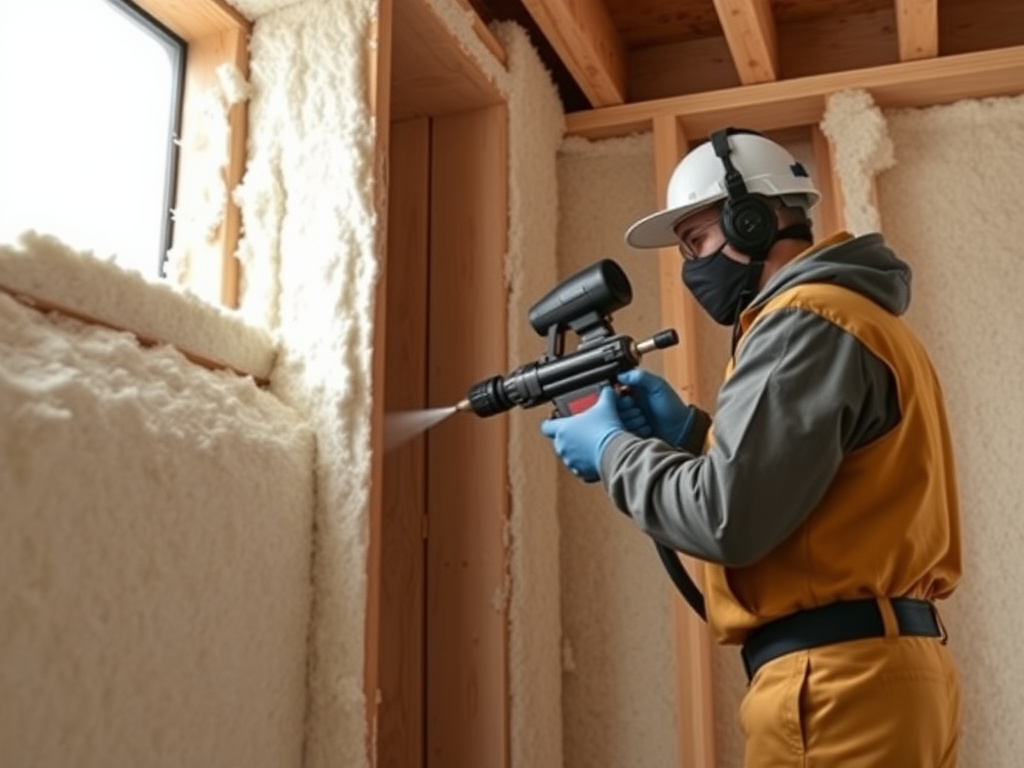
Closed-cell spray foam
Closed-Cell Spray Foam in Yuma, AZ — Maximum R-Value for Metal Buildings, Packing Sheds & Extreme Heat
Dense, rigid 2-lb foam that delivers nearly double the R-value per inch of open-cell, adds real structural rigidity, and functions as a genuine moisture barrier — the standard choice for Yuma County's metal buildings, agricultural packing sheds, and cold-storage facilities.
What closed-cell foam actually is
A dense, rigid foam built to insulate, strengthen, and seal out moisture
Closed-cell spray foam is a two-component polyurethane foam, like open-cell, but formulated to a much denser final state — roughly 2 pounds per cubic foot, versus open-cell's half-pound density. That density comes from a cellular structure where the tiny bubbles created during expansion are fully sealed off from one another, rather than open and interconnected. The practical result is a rigid, hard-surfaced material once cured, closer in feel to a dense packing foam than the soft, spongy texture of open-cell.
That sealed-cell structure is what gives closed-cell foam three properties open-cell doesn't have at any thickness: a substantially higher R-value per inch (roughly R-6 to R-7, versus open-cell's R-3.5 to R-3.8), genuine structural rigidity that adds racking strength to the assembly it's sprayed onto, and true vapor resistance — closed-cell foam applied at typical thickness functions as a Class II vapor retarder, a real, tested moisture barrier rather than just a low-permeance material.
Modern closed-cell formulations use HFO (hydrofluoroolefin) blowing agents — the current industry standard, replacing older high-global-warming-potential blowing agents used in earlier generations of the product. That matters less for day-to-day performance than it does for long-term formulation stability, but it's worth knowing the material you're getting reflects current chemistry, not a legacy formulation.
All three of those properties — R-value density, rigidity, and vapor resistance — are why closed-cell foam is the default choice for metal buildings, block and CMU walls, and any assembly where moisture control genuinely matters, rather than a nice-to-have upgrade to the same job open-cell would otherwise do. For the flexible, sound-dampening alternative better suited to standard residential attics and interior walls, see our open-cell spray foam page.
Yuma's genuine regional angle
Packing sheds and cold-storage buildings are where closed-cell foam earns its keep
Yuma is widely known as the "Winter Lettuce Capital of the World." From roughly November through April, the region produces an estimated 90%-plus of the leafy greens consumed across North America, off roughly 175,000 acres of irrigated cropland fed by some of the oldest water rights on the Colorado River — Yuma County ranks first in Arizona and third nationally for vegetable production. Unlike a border-crossing or import logistics point, Yuma is where this produce is actually grown, packed, cooled, and shipped out, which means the physical infrastructure that supports that harvest — packing sheds, pre-cooling facilities, and cold-storage buildings — is a real, recurring segment of the local building stock, not a theoretical commercial niche.
Those buildings have an insulation problem that a standard warehouse or retail building doesn't: a genuinely cooled interior surface sitting inside a desert climate where outside air, even at low ambient humidity most of the year, still carries enough moisture during the summer monsoon spike and even ordinary seasonal shifts to condense against a cold metal deck or panel that isn't properly isolated from it. Ordinary fiberglass batt or blown-in insulation doesn't stop that vapor drive — it slows heat transfer, but it does very little to block moisture from migrating through the assembly and reaching that cold surface. The result, in a poorly-specified building, is exactly what packing-shed operators describe as a "raining ceiling" — condensation forming on the underside of the metal roof deck and dripping onto product, equipment, and pallets below.
Closed-cell foam sprayed directly to the underside of the metal roof deck or against interior wall panels solves this two ways at once: its Class II vapor-retarder performance blocks the moisture migration that causes condensation, and its high R-value per inch cuts the refrigeration and pre-cooling load the facility's cooling equipment has to carry through the Nov–Apr harvest season. This is a fundamentally different commercial angle than a border-crossing import point managing already-cooled product moving through — Yuma's cold-storage buildings are doing the actual growing, packing, and shipping, which is precisely why this application shows up here at a scale it doesn't in most of the rest of Arizona. For the full commercial and agricultural picture, including project scheduling around harvest season, see our commercial spray foam page.
Where it goes
Best applications for closed-cell foam around Yuma County
Metal buildings and farm shops. Pole barns, farm equipment shops, and detached metal garages benefit from closed-cell's structural rigidity as much as its thermal performance — sprayed directly to the underside of a metal roof or wall panel, it stops both the summer heat gain and the condensation ("sweating") that bare metal buildings are prone to in Yuma's temperature swings between day and night.
Agricultural packing and cold-storage structures. As detailed above, packing sheds, pre-cooling facilities, and cold-storage buildings tied to the winter produce harvest need vapor-resistant, high-R assemblies to control condensation on cooled surfaces — this is the single most distinctive commercial use case in Yuma County.
Block and CMU walls. Concrete masonry unit walls, common in commercial and some residential construction across Yuma, take closed-cell foam well as an interior application — it bonds directly to masonry and adds a real vapor retarder against ground and wall moisture that block construction alone doesn't provide.
Flat and low-slope commercial roofs. Where roof-deck space is limited and every inch of thickness counts against parapet height or equipment clearances, closed-cell's higher R-value per inch delivers code-level performance in less material depth than open-cell would need.
| Density | About 2 pounds per cubic foot ("2-lb foam") — a rigid, dense cellular structure rather than a soft, flexible one. |
|---|---|
| R-value per inch | Roughly R-6 to R-7 per inch — nearly double open-cell's per-inch performance, which matters where framing depth is limited. |
| Structural contribution | Adds meaningful racking strength to a wall or roof assembly once cured, a genuine structural benefit open-cell doesn't provide. |
| Vapor behavior | Functions as a Class II vapor retarder at typical installed thickness — a real, tested moisture barrier, not just a low-permeance material. |
| Blowing agent | Modern formulations use HFO (hydrofluoroolefin) low-global-warming-potential blowing agents, the current industry standard replacing older high-GWP agents. |
| Best-suited surfaces | Metal roof decks and wall panels, block/CMU walls, and any assembly exposed to bulk moisture, condensation risk, or requiring added rigidity. |
General closed-cell foam characteristics — actual R-value achieved depends on installed thickness and deck or wall assembly.
Cost
What closed-cell spray foam typically costs in Yuma
As a directional range, closed-cell foam typically runs about $1.00 to $1.65 per board foot installed — meaningfully more than open-cell's $0.45 to $0.90 range, reflecting both the denser material and the higher R-value it delivers per inch of thickness. These figures are planning-level estimates for this region, not a guaranteed price; actual project cost depends heavily on deck type, access, and whether the job is residential or commercial in scale.
Worked example: a 5,000 square foot metal-roof farm shop or packing structure, sprayed with 2 inches of closed-cell foam across the roof deck to reach roughly R-13 to R-14 of added thermal resistance plus a full vapor-retarder seal, typically runs into the tens of thousands of dollars installed depending on deck condition, access equipment needed, and whether interior wall panels are included in the scope — we bid these individually rather than quoting a rough number, since commercial and agricultural building geometry varies too much for a single range to be honest. Why the added cost over open-cell pays off here isn't abstract: on a cooled packing or cold-storage structure, the cost of an uncontrolled condensation problem — damaged product, equipment corrosion, repeated remediation — routinely exceeds the incremental cost difference between the two foam types many times over across the life of the building.
On the residential side, a detached metal shop or RV garage sprayed with closed-cell typically carries a similar contractor minimum job charge as an open-cell attic job — roughly $1,500 to $2,200 — with total cost scaling from there based on square footage and thickness. Rebate-wise, the same landscape applies here as elsewhere on this site: APS's Home Performance path can offer up to $250 toward qualifying residential insulation upgrades, WACOG's Weatherization Assistance Program serves income-qualified households across Yuma, La Paz, and Mohave counties, and the federal 25C tax credit ended after December 31, 2025 and is not available for 2026 installs.
Moisture control
Moisture control on metal roofs and cooled structures
Yuma's day-to-day climate runs dry — this is genuine hot desert (Köppen BWh) territory, and humidity most of the year is low. But two things complicate the "it's always dry here" assumption for building assemblies: the summer monsoon season brings real, if brief, humidity spikes, and any building with a cooled interior surface — a cold-storage room, a pre-cooling dock, a walk-in facility — creates its own localized condensation risk regardless of outdoor humidity, simply because warm air meeting a cold surface condenses. That's a physics problem, not a weather problem, and it shows up in Yuma's agricultural buildings even on a bone-dry afternoon.
Closed-cell foam's Class II vapor-retarder performance addresses both scenarios at once: it blocks bulk moisture and vapor migration through the wall or roof assembly during a monsoon humidity spike, and it isolates a cooled interior surface from the warm exterior air that would otherwise drive condensation against it year-round. This is a meaningfully different specification conversation than a genuinely cold-climate site managing winter condensation risk — in Yuma, moisture control in agricultural and metal-building assemblies is almost entirely about managing engineered cold surfaces inside a hot exterior climate, not about seasonal freeze-thaw cycling.
Closed-cell vs. open-cell
Decision table: which foam fits your project
Neither foam type is universally "better" — they're specified for different jobs. Closed-cell wins wherever rigidity, maximum R-value per inch, or genuine moisture control is part of the requirement. Open-cell wins on cost per board foot and sound-dampening in standard residential attics and interior walls where those extra properties aren't needed.
| Best fit | Metal buildings, agricultural packing sheds and cold-storage structures, block/CMU walls, flat commercial roofs, and any assembly needing real moisture control or added rigidity. |
|---|---|
| Cost position | Higher installed cost per board foot than open-cell, offset in commercial and agricultural settings by needing less thickness to reach a given R-value and by its structural and moisture-control contribution. |
| When we'd steer you to open-cell instead | Standard residential attics and interior walls where sound dampening and lower cost per board foot outweigh the need for rigidity or a vapor retarder. |
For the residential attic and interior-wall case, see our open-cell spray foam page.
A lot of Yuma-area projects end up using both — open-cell in the main residential attic for cost efficiency, closed-cell in an attached metal shop, garage, or ag structure where rigidity and moisture control matter. We'll tell you plainly which combination fits your property rather than defaulting to the higher-margin option. Read the full open-cell breakdown on our open-cell spray foam page, or see the complete cost and climate picture in our Yuma spray foam cost & climate guide.
Install process
What happens on a closed-cell spray foam install
Inspect & spec the assembly
We assess deck or wall type, existing moisture conditions, and the R-value and vapor-control target for the specific building — residential shop, farm structure, or commercial cold-storage facility.
Prep the space
Surfaces are cleaned and prepped for adhesion, equipment and product are protected or relocated, and — for occupied agricultural or commercial buildings — work is scheduled around operating hours where needed.
Spray application
Foam is applied in controlled passes to reach target thickness, with technicians monitoring density and adhesion throughout — critical on metal decks where proper bonding is what delivers the added rigidity.
Cure, inspect & walkthrough
We walk the finished assembly with you, confirm the foam is fully sealed at seams and penetrations where condensation risk concentrates, and document the R-value and vapor-retarder performance achieved.
Code compliance basics
What code requires for closed-cell foam installs
Like open-cell, closed-cell foam applied at the roof deck to create a sealed (unvented) attic or building assembly falls under IRC Section R806.5's conditions for unvented assemblies. Closed-cell's air-impermeable, vapor-retarder properties make it a straightforward fit for that code path, and it's a standard, recognized method for metal building roof-deck applications specifically.
Thermal barrier and ignition barrier requirements apply here too — exposed foam in occupied or storage-accessible space typically needs an approved thermal barrier (commonly drywall) or an approved ignition-barrier coating, and commercial agricultural buildings may have additional occupancy-specific code requirements worth confirming with your local jurisdiction before work begins.
- ✓Confirm unvented-assembly conditions under IRC R806.5 for roof-deck applications
- ✓Verify ignition-barrier or thermal-barrier requirements are met for any exposed foam in occupied space
- ✓Confirm any occupancy-specific code requirements for agricultural or commercial structures
- ✓Document vapor-retarder performance and R-value achieved for facility records
- ✓Confirm permit requirements with your local jurisdiction, particularly for commercial and ag-building scopes
Common questions
Closed-cell spray foam FAQ
Why does closed-cell foam matter so much for Yuma County's packing sheds and cold-storage buildings?
+
Yuma is known as the Winter Lettuce Capital of the World, producing an estimated 90%+ of the leafy greens grown in North America each November through April, off roughly 175,000 irrigated acres. That harvest season runs through a network of packing sheds, pre-cooling facilities, and cold-storage buildings where interior surfaces run far colder than the ambient desert air outside. When warm, humid outside air contacts a cooled metal roof deck or wall panel without a proper vapor-resistant assembly, the result is condensation forming inside the building — sometimes literally dripping from the ceiling. Closed-cell foam's Class II vapor-retarder performance, applied directly to the metal deck or panel, is what stops that condensation cycle before it starts.
How much does closed-cell spray foam cost in Yuma?
+
As a directional range, closed-cell typically runs about $1.00 to $1.65 per board foot installed — noticeably more than open-cell's $0.45 to $0.90 range, but it delivers roughly double the R-value per inch, so less material thickness is needed to hit the same target. Commercial and agricultural jobs are priced individually based on square footage, deck type, and access, and we'll always give you an itemized bid rather than a rough per-square-foot number for anything beyond a standard home.
Does closed-cell foam actually add strength to a metal building?
+
Yes — once cured, closed-cell foam bonds rigidly to the metal deck or wall panel and measurably increases the assembly's resistance to racking and wind uplift forces, which is one reason it's the standard choice for pole barns, farm shops, and metal packing structures across Yuma County, independent of its insulating value.
Is closed-cell foam overkill for a typical Yuma house?
+
For most homes, no — a standard attic roof deck or residential wall assembly is well served by open-cell foam, and we'll tell you plainly when closed-cell isn't worth the added cost. Where closed-cell earns its place on a residential job is a detached metal shop or RV garage, an exterior wall exposed to bulk water, or a flat or low-slope roof section where its rigidity and moisture resistance genuinely change the outcome.
Ready to spec closed-cell foam for your building?
Tell us about your property — home, shop, or ag/commercial structure — and we'll come back with a straightforward closed-cell plan, no obligation.
Related reading
Go deeper on foam choice and commercial applications
Open-Cell Spray Foam
Lower cost per board foot and real sound-dampening performance for standard Yuma home attics and interior walls.
Attic Insulation
Sealed vs. conventional attic strategies for Yuma's 140–160°F attic temperatures, plus current rebate options.
Yuma Spray Foam Cost & Climate Guide
Full cost tables, savings modeling, and the extreme-heat climate breakdown behind every number on this page.