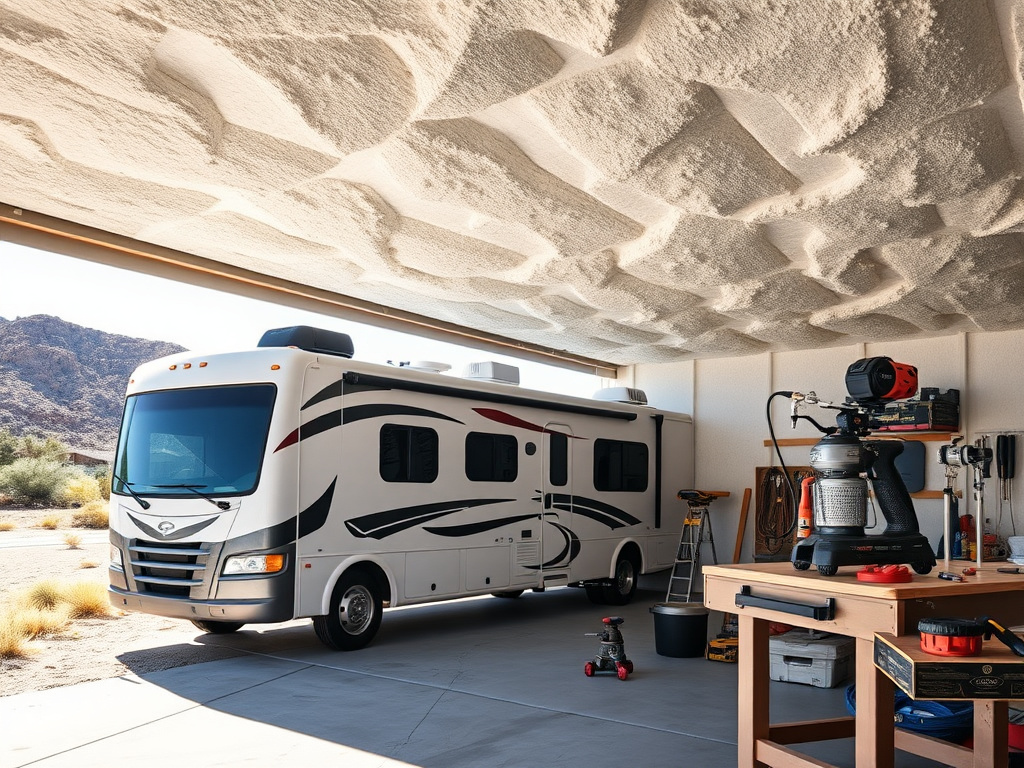
Garages, shops & RV buildings
Garage & RV Insulation — Yuma & Yuma County
A garage, shop, or RV building with a bare ceiling and walls fights Yuma's sustained summer heat with nothing on its side. Spray foam seals the envelope, whether it's an attached two-car garage, a home workshop, or a detached RV garage at a winter-resort property.
The regional problem
Why garages, shops & RV buildings are their own problem here
A generic garage-insulation checklist written for a mild climate doesn't hold up across Yuma and Yuma County. This is IECC Climate Zone 2B with genuinely sustained extreme heat — 100°F+ days running from June through September, and an interior garage or shop temperature that can climb to 120–140°F or more by mid-afternoon, often hotter than the ambient air outside once a metal roof or an uninsulated ceiling has been absorbing sun for hours.
That's only half the picture. Yuma County's population genuinely doubles every winter with snowbirds and RV-resort residents, supported by an extensive network of RV parks and resorts across the area. That seasonal population swing drives a real, distinct demand for RV garage insulation, toy-hauler building insulation, and manufactured-home-adjacent structures — a service line no generic "garage insulation" search result is written to address.
An attached garage adds its own wrinkle: it's usually connected to the house by a single interior wall that was never built to be a real thermal boundary. In a Yuma summer, that wall lets garage heat migrate straight into the living space, working against the air conditioner around the clock rather than just during the hottest part of the day.
Detached shops, RV garages, and farm equipment bays have a different version of the same problem — usually a bare metal or block skin with essentially no insulating value, holding stored vehicles, tools, and equipment at whatever temperature the outside air happens to be. Spray foam doesn't eliminate that exposure entirely, but it meaningfully narrows the swing, which is the actual goal for most of the properties we work on.
Where to start
What to insulate, and the order that actually matters
Most garage, shop, and RV building projects don't need every surface insulated on day one. We prioritize by where the heat gain is actually happening, so a budget-limited project still targets the highest-impact surface first.
- ✓Ceiling or roof deck first — the single largest surface exposed to direct summer solar load, and the fastest path for heat to migrate into the space below.
- ✓Shared wall with the house next — on an attached garage, the wall between the garage and living space is often the thinnest thermal boundary in the whole home.
- ✓Exterior walls third — especially on detached shops, RV garages, and metal buildings where the wall assembly is frequently a single uninsulated metal or block skin.
- ✓Garage door last — weatherstripping and an insulated door panel help at the margins, but they matter far less once the ceiling and shared wall are actually sealed.
On an attached garage, the ceiling and the shared house wall together usually account for most of the heat transfer we can measure. On a detached shop, RV garage, or metal building, the calculus shifts toward the roof and exterior wall skin, since there's no shared wall with a conditioned house to worry about — but there's often a bare metal surface to deal with instead.
Conversions
Spray foam for shop, garage & casita conversions
Garages and outbuildings across Yuma County get converted into real working or living space more often than most insulation guides assume — a trend that has picked up alongside the area's growing winter-visitor and rental-income market. Spray foam is usually the right call for a conversion because it seals the assembly in one pass, rather than relying on separate air-sealing and batt-insulation steps that leave gaps at penetrations and framing.
- ✓Home workshops and tool storage where summer interior temperatures of 120–140°F make the space unusable for most of the year without real conditioning.
- ✓Hobby and craft spaces, home gyms, and flex rooms converted from garage square footage that need an actual code-compliant thermal envelope, not just a window unit fighting a losing battle.
- ✓Casita and rental-income conversions, which have grown alongside Yuma County's winter-visitor population as extended family or seasonal renters look for separate living space on the same property.
- ✓Farm and ranch equipment bays where temperature swings affect batteries, fluids, and stored tools as much as the people working in them.
For any conversion where the space becomes occupied living or working space rather than simple storage, the applicable thermal- and ignition-barrier code requirements change — see the code notes further down this page before finishing walls or drywall over foam.
RV garages, shops & farm buildings
Detached shops, RV garages & metal farm buildings: why closed-cell wins here
Metal-frame RV garages, pole buildings, and farm equipment shops are the default construction type for a large share of the detached buildings across Yuma County — from RV-resort properties to working farms around Wellton and Somerton. A bare metal skin creates a specific problem that a typical drywalled garage doesn't have to deal with: condensation.
| The core problem | A bare metal RV garage or pole-building skin has almost no insulating value on its own and tracks the outside temperature closely — an interior that can run hotter than the ambient air once the sun has been on the roof all afternoon. |
|---|---|
| Condensation risk | When warm, humid air — common during the summer monsoon spike — contacts a metal surface that's cooled overnight, it condenses, dripping onto a stored RV, tools, or farm equipment inside. |
| Why closed-cell is the default here | Closed-cell spray foam bonds directly to the metal skin and acts as a vapor retarder at typical application thickness, stopping the condensation cycle at the surface instead of just slowing the temperature swing around it. |
| Added benefit | Closed-cell foam also adds meaningful racking strength to a metal building's wall and roof assembly — a structural side benefit that open-cell foam and batt insulation don't provide. |
| Where we see this most | RV garages and toy-hauler buildings at Yuma-area RV resorts, and detached farm and ranch equipment shops across Wellton and the surrounding county, where metal-frame construction is the norm. |
Why closed-cell spray foam is our default recommendation for RV garage, shop, and metal building interiors across Yuma County.
For the full technical comparison between closed-cell and open-cell foam — density, R-value per inch, and when each one is the right call — see our closed-cell spray foam page. For the broader picture on insulating manufactured homes and other seasonal-occupancy properties tied to the winter-visitor season, see our guide on snowbird-season RV and manufactured-home insulation.
Cost & code
Cost ranges and code notes
Garage, shop, and RV building spray foam pricing follows the same board-foot logic as the rest of a spray foam project — square footage, foam type, and application thickness all move the number. A typical attached two-car garage ceiling-and- shared-wall project tends to land in a modest range compared to a whole-house attic job, simply because the surface area is smaller. A detached RV garage or farm shop scales differently depending on roof pitch, wall height, and whether the whole building envelope is in scope or just the roof deck.
Treat every figure on this page as directional. Rural properties across Wellton and outlying Yuma County sometimes carry a slightly wider cost range than in-town Yuma or Fortuna Foothills jobs, purely because of travel distance and site access — we're upfront about that during the quote rather than after the crew shows up.
On the code side, spray foam in a garage, shop, or RV building is a recognized, compliant insulation method — but the specific barrier requirement depends on how the space is used. Occupied space needs a real thermal barrier over the foam. Unoccupied storage or attic space can sometimes use an ignition-barrier coating instead. A garage-to-casita conversion typically needs to meet the same standard as the rest of the house.
| Thermal barrier | Open-cell and closed-cell spray foam used inside occupied or living-adjacent space generally requires a 15-minute thermal barrier — typically 1/2-inch drywall — over the foam, the same as standard residential code practice. |
|---|---|
| Ignition barrier | In unoccupied attic, crawlspace, or storage-only applications where a full thermal barrier isn't practical, a code-compliant ignition-barrier coating or approved foam product is used instead — a separate requirement from the thermal barrier, specified based on how the space is actually used. |
| Detached shops, RV garages & metal buildings | A detached shop, RV garage, or farm building used for storage or equipment — not living space — is evaluated differently than a converted home office or living-adjacent garage. We confirm the applicable requirement for your specific structure before quoting, not after. |
| Garage-to-casita conversions | Once a garage bay is converted into a casita, office, gym, or rental unit, it's generally held to the same thermal- and ignition-barrier standards as the rest of the house — worth confirming before drywall goes up over the foam. |
General code patterns for spray foam in garage, shop, and RV building applications — we confirm the specific requirement for your structure before quoting.
Walk the space
We look at ceiling, shared walls, exterior walls, and door condition to build the priority order for your specific garage, shop, or RV building.
Confirm the code path
Occupied space, working shop, or unoccupied storage each carry a different thermal/ignition-barrier requirement — we confirm before quoting.
Quote by priority
You get a scoped quote that can start with the highest-impact surface and expand later, not an all-or-nothing number.
Spray & finish
Foam goes in, cures, and any required barrier finish (drywall or coating) is completed to code before handoff.
Questions
Garage & RV insulation questions we hear most
Is spray foam worth it for a garage or shop in a climate this hot?
+
Yes, and it matters more here than in most of Arizona. Yuma logs more sustained 100°F+ days than almost anywhere else in the state, and an uninsulated garage or shop can run hotter inside than the outside air by mid-afternoon. Sealing the ceiling and shared wall first is what actually moves the needle.
Do you insulate RV garages and toy-hauler buildings, not just attached house garages?
+
Yes — RV garages, toy-hauler buildings, and detached shops are a significant part of our work given how many winter-visitor properties and RV resorts sit across Yuma County. Closed-cell foam is usually the right call on these because of the condensation and structural benefits a metal skin needs.
What's a typical cost range to spray foam a garage or shop?
+
It depends on square footage, ceiling height, foam type, and whether the shared wall with the house is included. Treat any figure you see online as a directional starting point — we'll walk your specific space and come back with a real range before any work is scheduled.
Is spray foam in a garage or shop code-legal, and do I need a permit?
+
Spray foam is a recognized, code-compliant insulation method, but the thermal-barrier and ignition-barrier requirement differs depending on whether the space is occupied living space, a working shop, or unoccupied storage. We confirm the applicable requirement for your structure and handle the permit conversation as part of the quote.
Get your garage, shop, or RV building insulated for the Yuma heat
Tell us whether it's an attached garage, a home workshop, or a detached RV garage or farm shop and we'll come back with a priority-ordered plan — no obligation.
Related reading
Go deeper on foam type and seasonal-property insulation
Closed-Cell Spray Foam
Higher R-value per inch, added rigidity, and condensation control — the usual pick for metal RV garages, shops, and farm buildings.
Snowbird Season: RV & Manufactured-Home Insulation
How Yuma County's winter-visitor population shapes RV garage, manufactured-home, and seasonal-occupancy insulation needs.
Service Areas
Local property notes for Yuma, San Luis, Somerton, Wellton, and Fortuna Foothills.