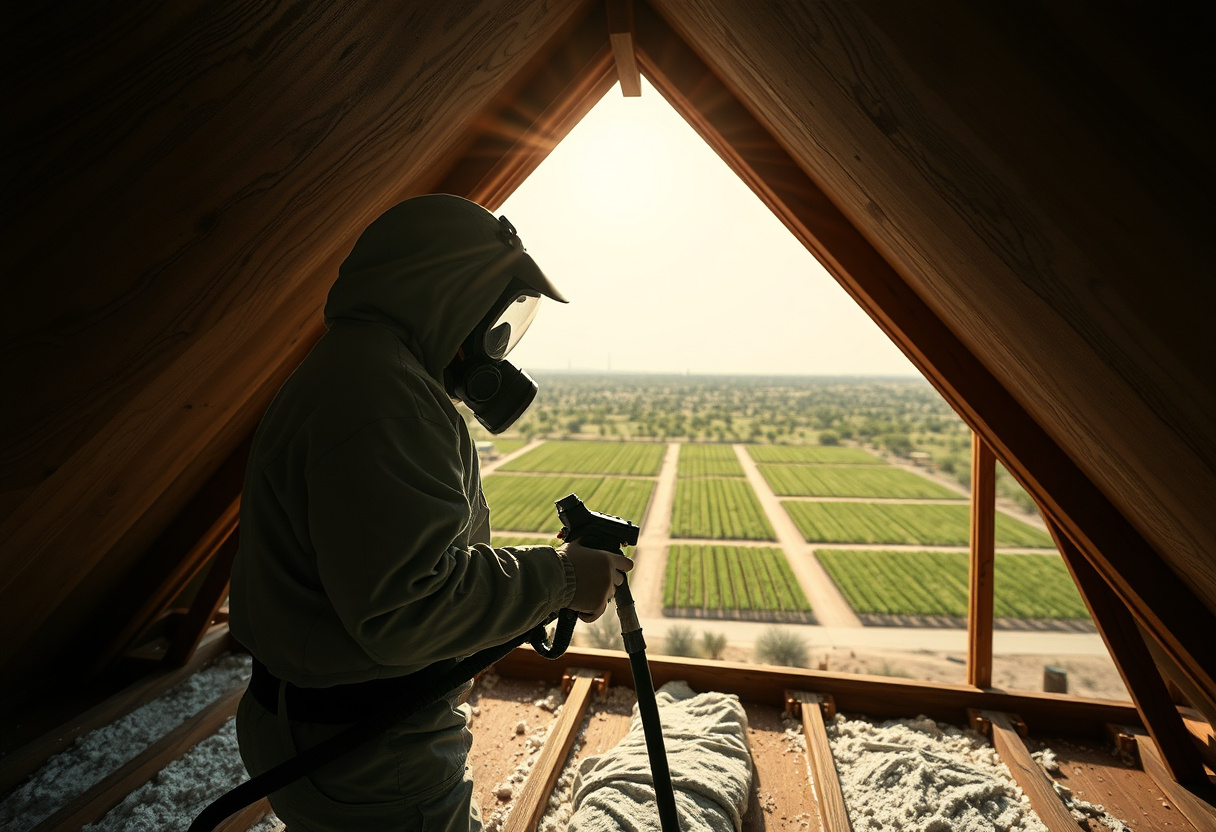
24 questions, 4 topics
Spray Foam Insulation FAQ for Yuma, AZ & Yuma County
Cost and rebates, Yuma's extreme desert climate, agriculture and RV/manufactured-home properties, and installation process and safety — the questions we hear most, answered in one place and organized by topic so you can jump straight to what's relevant to your property.
Cost & rebates
Cost & Rebates
How much does spray foam insulation cost in Yuma, AZ?
+
Spray foam is typically priced per board foot, and a full attic roof-deck job on a 1,500–2,200 sq ft Yuma home generally lands in the neighborhood of $2,250–$5,000 installed, with a typical contractor minimum job charge around $1,500–$2,200. Those figures are directional statewide-Arizona ranges, not a quote — your actual price depends on foam type, thickness, access, and whether old insulation needs to come out first, so treat any number here as a planning estimate until we've looked at your property.
What's a "board foot" and why is spray foam priced that way?
+
A board foot is a 12-inch by 12-inch area sprayed to one inch of thickness, and it's the standard unit spray foam contractors use to price material and labor together, since both scale with volume, not just square footage. That's why two quotes for the same square footage can differ if one spec calls for a thicker application or a different foam density — the board-foot math is doing real work behind the number, not padding it.
Are there rebates for insulation in Yuma in 2026?
+
Yes, two real programs apply here. Arizona Public Service (APS), the utility serving all of Yuma County, offers a Home Performance rebate of up to $250 when existing attic insulation at R-7 or less is brought up to R-43. Separately, the Western Arizona Council of Governments (WACOG) runs a federally-backed Weatherization Assistance Program that can cover attic insulation and air sealing at no cost for income-qualified households and renters. We can tell you which of these applies to your property during a quote.
Is the federal tax credit for insulation still available in 2026?
+
No. The federal Energy Efficient Home Improvement Credit (Section 25C) ended for any work installed after December 31, 2025, under the One Big Beautiful Bill Act. If you were planning around that credit, it's no longer part of the math for a 2026 project — the APS rebate and WACOG program above are the incentives that still genuinely apply in Yuma County this year.
How long until spray foam pays for itself in Yuma's climate?
+
A sealed, properly insulated envelope commonly cuts cooling costs by roughly 20–40%, which for many Yuma homes works out to an estimated $700–$1,300 a year, with a typical payback window of 3–7 years. Those are directional planning figures pulled from general Zone 2B performance patterns, not a guarantee for your specific house — your actual savings depend on your current insulation condition, ductwork, and how the home is used.
Does spray foam increase home value in the Yuma market?
+
It can be a genuine selling point in a market where buyers are increasingly asking about summer cooling costs, since a documented, professionally installed spray foam system signals lower utility bills and a tighter, more comfortable home. We can't promise a specific appraisal bump, but it's a real, quotable improvement to point to during a sale, distinct from cosmetic upgrades that don't affect how the house performs.
Every cost figure above is a directional planning estimate, not a quote — the fastest way to get real numbers for your property is a professional energy audit. For the full cost breakdown by scenario, tables, and a detailed look at the APS and WACOG programs, see our 2026 Yuma spray foam cost & climate guide.
Yuma's extreme desert climate & performance
Yuma's Extreme Desert Climate & Performance
Is Yuma really hotter than Phoenix?
+
Yuma sits at a much lower elevation than Phoenix — roughly 70–140 feet versus Phoenix's ~1,100 feet — and gets fewer monsoon-storm interruptions, so it frequently logs more consecutive 100°F+ days per year even though Phoenix can edge it out on isolated single-day peak readings. In practical terms, Yuma's cooling season runs longer and more continuously than Phoenix's, which is exactly why we spec insulation for sustained heat exposure, not just a summer peak.
What IECC climate zone is Yuma in, and what does that mean for insulation?
+
Yuma is IECC Climate Zone 2B (Hot-Dry) — the same numeric zone as Phoenix, but with more sustained extreme summer heat and essentially no winter cold to offset it. Zone 2B insulation planning here is almost entirely a cooling-load problem: R-38 attic insulation is the code-derived floor, with R-49 as the recommended target for new work, and wall cavities generally spec to an R-13 minimum.
How hot do Yuma attics actually get?
+
Unconditioned attics in Yuma commonly reach 140–160°F or higher on summer afternoons, driven by both the extended heat season and Yuma's genuinely intense year-round sun exposure. That heat radiates straight down into living space through an under-insulated ceiling, which is why attic and roof-deck spray foam is consistently the single highest-impact job we do in this market.
Does Yuma's near-zero winter cold change how insulation should be specified compared to other parts of Arizona?
+
Yes. Yuma's January average high is around 70°F with lows near 51°F, and sub-freezing nights are rare and brief — a genuinely different winter than the dual-season climate parts of southeastern Arizona see. That means we don't have to balance a real heating season against the cooling load the way a mixed-climate region does; nearly every spec decision here is optimized around keeping heat out, not retaining it.
Does spray foam help with Yuma's intense year-round sun exposure, not just summer heat?
+
Yes. Yuma is one of the sunniest places in the country, with roughly 91% of possible daylight hours receiving sunshine annually, which drives constant solar heat gain into the roof deck even outside the hottest summer stretch. A sealed spray foam envelope reduces how much of that year-round solar load actually makes it into your living space or storage building, not just the heat from June through September.
Will spray foam affect my roof or shingle warranty?
+
It can, depending on the roofing manufacturer and how the spray foam is applied, so we check your specific roofing product's installation requirements before starting any roof-deck job. In most cases a properly installed, code-compliant application doesn't create a conflict, but it's a question worth confirming for your roof rather than assuming either way.
Do I still need attic ventilation after spray foam?
+
It depends on the assembly. A vented attic with insulation at the floor generally keeps its existing ventilation, while an unvented, roof-deck spray foam application is designed to create a conditioned attic space that doesn't rely on outside airflow the same way. We size and detail the assembly to current code requirements so you end up with a system that's built to work as a whole, not ventilation left over from a different approach.
Attic and roof-deck performance is the single biggest lever in Yuma's Zone 2B climate — see our attic insulation service for how we spec that work, and our service areas page for how conditions vary across Yuma, San Luis, Somerton, Wellton, and Fortuna Foothills.
Agriculture, packing sheds & seasonal/RV properties
Agriculture, Packing Sheds & Seasonal/RV Properties
Why does packing-shed and cold-storage insulation matter so much in Yuma County?
+
Yuma County produces an estimated 90%+ of the leafy greens consumed in North America each winter, earning it the nickname "Winter Lettuce Capital of the World," with roughly 175,000 irrigated acres in production and packing operations running full tilt from November through April. That volume means real, ongoing demand for packing-shed, pre-cooling, and cold-storage buildings that hold temperature and manage moisture correctly — a commercial niche this region has at a scale most Arizona markets simply don't.
What's different about insulating a produce packing shed or pre-cooling facility vs. a regular commercial building?
+
Packing and cold-storage buildings deal with constant temperature differentials and humidity from washing, cooling, and refrigeration processes, which creates condensation and moisture problems that ordinary insulation doesn't solve. Closed-cell spray foam's rigid, largely moisture-resistant structure is generally the right fit for these assemblies, applied to the metal-building specifics of a working ag facility rather than a standard office or warehouse spec.
Do you insulate farm shops, barns, and agricultural outbuildings?
+
Yes — farm shops, equipment barns, and other agricultural outbuildings across Wellton and the rest of rural Yuma County are a regular part of our commercial work. These buildings usually have their own access and scheduling considerations tied to farm operations, and we plan around that rather than treating them like a standard in-town commercial job.
Can you insulate a manufactured home, park-model home, or RV garage?
+
Yes. Manufactured and park-model homes have different framing and access constraints than a stick-built house, and RV garages often need a mix of thermal and sound-dampening performance, so we spec each of these differently rather than applying a standard residential-attic approach to all three.
Does the winter snowbird population change how you schedule or price jobs?
+
Yes, in a real way. Yuma County's population roughly doubles every winter with snowbirds and RV-resort residents, which means seasonal-occupancy homes, casita conversions, and RV-adjacent structures see a genuine demand spike in the cooler months. We schedule around that seasonal rhythm and price jobs based on the actual property and access involved, not a flat year-round assumption.
Packing-shed and cold-storage work is this region's standout commercial niche — see our commercial spray foam service and our deep dive on insulating Yuma's packing sheds and cold-storage buildings for how we approach the winter harvest season.
Process, safety & practicalities
Process, Safety & Practicalities
Is spray foam safe? What about off-gassing?
+
Properly installed spray foam is a widely used, code-recognized building material, and any off-gassing during the chemical cure process is temporary — occupants and pets are generally kept out of the immediate work area during application and for a short re-occupancy window afterward, typically around 24 hours. We follow standard manufacturer cure guidance on every job so the space is safe to return to on a predictable timeline.
Can I DIY spray foam with a hardware-store kit?
+
Small hardware-store kits exist for minor gap-filling, but whole-building applications — attic roof decks, wall cavities, commercial structures — require professional equipment, correct mixing ratios, and code-compliant thickness and ignition-barrier detailing that a small kit isn't built to deliver. Getting the ratio or application wrong can mean poor expansion, weak adhesion, or a job that doesn't meet code, which is a real risk on anything beyond a small DIY patch.
How long does installation take and how messy is it?
+
Most residential attic jobs are completed in a single day, with commercial and larger agricultural buildings taking longer depending on square footage. Spray foam application does involve masking off adjacent surfaces and a genuine cure/re-occupancy window afterward, but a professional crew keeps overspray contained and leaves the work area clean once the job is done.
Do I need to remove old insulation before spray foaming?
+
Often, yes — old, settled, or pest-contaminated insulation generally needs to come out before spray foam goes in, since spraying over degraded material doesn't give you a clean, code-compliant assembly. We assess the existing insulation during a quote and tell you plainly whether removal is needed for your property rather than skipping that step to save time.
Is spray foam code-legal in Yuma? Do I need a permit?
+
Yes, spray foam is a recognized insulation material under the building code that applies in Yuma and Yuma County, and unvented roof-deck assemblies follow specific code provisions covering thermal and ignition barriers. Permit requirements depend on the scope of the job and the jurisdiction, and we handle that determination as part of planning the work rather than leaving it for you to sort out.
What happens during a professional energy audit?
+
A real energy audit looks at where your home or building is actually losing conditioned air — attic and wall insulation levels, air sealing at penetrations, and ductwork condition — often using a thermal imaging camera to find problem areas that aren't visible otherwise. The goal is to identify what's actually driving your cooling costs before you pay for insulation work you may not need, or miss a bigger issue insulation alone won't fix.
If your job needs old material out first, see our insulation removal service, or request a free quote and we'll walk you through what your specific property needs.
Still have a question about your property?
Tell us about your home, farm building, or packing shed and we'll answer directly — no obligation, no generic desert-AZ template.