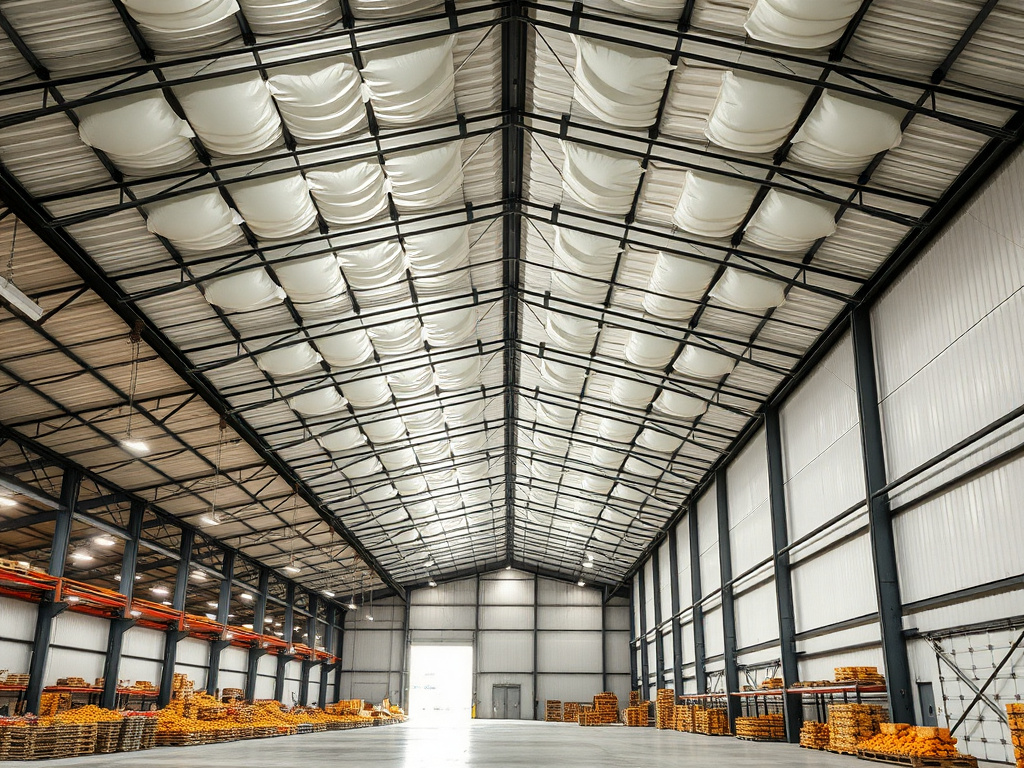
Commercial & agricultural
Commercial & Agricultural Spray Foam Insulation — Yuma's Packing Sheds, Cold Storage & Metal Buildings
Yuma County isn't a stop along the produce supply chain — it's where a huge share of North America's winter leafy greens are actually grown, packed, cooled, and shipped out. That production economy puts real, recurring demand on the building envelope, and closed-cell spray foam is the material built to answer it.
Who we serve
From produce packing sheds to retail buildout — the full commercial envelope
Our commercial and agricultural work covers a wider range of buildings than the phrase “commercial spray foam” usually suggests. On the agricultural side, that means produce packing sheds, pre-cooling facilities, cold-storage buildings, and general agricultural processing structures tied directly to Yuma County’s harvest economy. On the general commercial side, it means metal-building warehouses, self-storage facilities, churches, offices, restaurants, and retail buildout — any structure where the roof deck or wall assembly needs a real envelope, not a minimum-code afterthought.
What ties all of it together is the same underlying material logic: closed-cell spray foam gives a metal or block building a continuous, high-R, moisture-managing envelope in a single application, instead of stitching together separate vapor, insulation, and air-sealing layers that have to be installed and maintained correctly in sequence.
We also work adjacent to Yuma’s military and institutional presence — Marine Corps Air Station Yuma and the Yuma Proving Ground both sit within the broader service area, and a fair amount of our agricultural and industrial client base does business near that corridor. That’s context for the kind of large-format, logistics-aware work we’re used to running — background context, not the main point; the packing-shed and cold-storage work below is the real standout.
If your project is a new commercial build rather than a retrofit, see our new-construction spray foam page for how we approach envelope design at the framing stage.
The Yuma agricultural angle
Yuma County is the Winter Lettuce Capital of the World — and that changes what a commercial envelope has to do
This is genuinely the most distinctive commercial angle in our service area, and it is worth understanding in plain terms. From roughly November through April, Yuma County produces an estimated 90%+ of the leafy greens consumed across North America — lettuce, spinach, broccoli, and related winter vegetable crops grown across roughly 175,000 irrigated acres fed by some of the oldest water rights on the Colorado River. Yuma County ranks first in Arizona and third in the nation for vegetable production. That volume of produce doesn’t just get picked and trucked out — it moves through a real chain of packing sheds, pre-cooling facilities, and cold-storage buildings first, all concentrated in and around this same service area, all running hardest during the exact months when the building envelope matters most.
That makes Yuma a production region, not a pass-through point. The building-science problem that follows from that is specific: a packing shed or pre-cooling facility has to hold a cooled interior environment against Yuma’s sustained, extreme exterior heat, and every time warm, humid outside air meets a cold interior surface — a metal roof deck, an uninsulated wall panel, a refrigerated dock door frame — condensation forms. On an ordinary building that’s an inconvenience. On a facility handling fresh produce, it’s a real operational and food-safety problem: dripping ceilings over product, corroding metal panels, mold risk in a humid pocket, and equipment that has to work harder to fight a building envelope that’s actively working against it.
Conventional metal-building insulation — a vinyl-faced batt draped over purlins, for instance — was never designed to solve that problem. It compresses at the fasteners, leaves gaps at penetrations, and does nothing to stop vapor drive through the assembly. Closed-cell spray foam is applied directly to the underside of the roof deck or wall panel as a continuous, adhered layer, which closes those gaps entirely and adds genuine vapor-retarder performance at the same time. For a packing shed or cold-storage building, that’s not an optional extra — it’s the difference between an envelope that manages the temperature differential and one that fights it every day of the harvest season.
We’ve written a longer, dedicated breakdown of this exact problem — read Insulating Yuma’s Packing Sheds and Cold-Storage Buildings for the full walk-through of what the Winter Lettuce Capital’s production economy actually needs from a building envelope, and why closed-cell foam is the material that answers it.
Material fit
Why closed-cell foam is the default for metal buildings and refrigerated structures
We use closed-cell foam as the default material across nearly all of our commercial and agricultural work, for the same reasons it fits packing sheds and cold storage. Full material comparison lives on our closed-cell spray foam page — the specs that matter most for commercial buildings are below.
| Density & yield | 2-lb closed-cell foam, roughly R-6 to R-7 per inch — meaningfully higher R-per-inch than open-cell, which matters when a metal-building roof deck or wall cavity has limited depth to work with. |
|---|---|
| Vapor performance | Functions as a Class II vapor retarder at typical application thickness. On a refrigerated or pre-cooled building, that's the difference between a roof deck that stays dry and one that develops a chronic interior drip during humid stretches. |
| Structural contribution | Rigid, closed-cell material adds real racking strength to a metal-building wall or roof assembly — a secondary benefit that matters on pre-engineered ag and warehouse structures where the skin isn't doing much structural work on its own. |
| Best-fit assemblies | Metal building roof decks and walls, packing-shed and pre-cooling envelopes, block/CMU commercial walls, flat commercial roof retrofits, and agricultural processing buildings where condensation control is the primary design driver. |
Directional specifications for 2-lb closed-cell foam as typically applied on Yuma-area commercial and agricultural structures — confirmed spec depends on assembly and site conditions.
Energy math
Refrigeration and pre-cooling loads during peak harvest season
Pre-cooling and cold-storage equipment is sized to pull heat out of fresh produce quickly and hold it at a target temperature — but it’s doing that job against whatever heat load the building envelope lets in. In Yuma’s IECC Zone 2B climate, with sustained summer highs regularly in the 100–108°F range and unconditioned metal-building interiors climbing well beyond that, an uninsulated or poorly insulated envelope forces refrigeration equipment to run longer and harder than its design spec assumes, every single day of the November–April peak season.
A continuously applied closed-cell envelope cuts that conductive and infiltration heat gain directly, which shows up as reduced refrigeration runtime and less temperature swing inside the cooled space — exactly the kind of stability that matters for product quality during a high-volume packing run.
We frame commercial energy figures directionally rather than as guaranteed numbers, since actual savings depend on the specific facility, existing equipment condition, and current envelope state. What we can say plainly: an envelope that isn’t actively working against a refrigeration system is a lower-runtime, lower-wear system by default, and that compounds over a five-month peak season, year after year.
For facilities weighing envelope work against equipment upgrades, an energy audit is often the right first step to see where the building itself is losing the fight before any equipment decision gets made.
Code & spec basics
Commercial envelope code and spec fundamentals
- ✓Thermal and ignition barrier requirements apply to spray foam in occupied commercial spaces the same way they apply residentially — we spec the correct barrier system per area of use.
- ✓Metal-building roof and wall assemblies are evaluated against IECC Zone 2B commercial prescriptive paths, which set minimum continuous-insulation and cavity-insulation targets by assembly type.
- ✓Refrigerated and pre-cooled spaces carry additional vapor-control expectations beyond the base commercial energy code, since uncontrolled vapor drive is a facility-condition risk, not just an energy-code checkbox.
- ✓Flat commercial roof retrofits are evaluated for existing roof condition, drainage, and re-cover versus tear-off before a spray foam roofing spec is finalized.
- ✓We confirm the applicable code path and any local permitting requirement per project before work is scheduled — commercial specs vary more by building type and use than residential work does.
Project logistics
Scheduling around the November–April harvest season
Scope the facility
Walk the building with facility management to confirm assembly type, current envelope condition, and any operational constraints specific to a working packing or cold-storage site.
Plan around peak season
November through April is peak activity for packing and pre-cooling operations countywide. Where possible, we schedule envelope work for the off-season — roughly May through October — to avoid disrupting an active harvest run.
Coordinate occupied-facility work
When a project can't wait for the off-season, we plan around active operating hours, including after-hours or weekend spraying, so a working facility isn't taken offline during its busiest stretch.
Spray, cure, walkthrough
Application and cure timelines are scoped per project size — a farm shop and a full packing-facility roof deck are very different jobs — with a final walkthrough before the space goes back into full use.
RV-resort clubhouses and amenity buildings tied to Yuma’s winter-visitor season, and general farm and ranch outbuildings countywide, follow this same logistics pattern — we scope the building, plan around its actual usage calendar, and quote it as its own project rather than a generic commercial line item.
Ongoing envelope condition
Packing-shed envelope maintenance and adjacent building types
Closed-cell spray foam is a long-lived material, but a working packing shed or cold-storage building is a genuinely demanding environment — forklift traffic, pressure-washing during sanitation cycles, and repeated door-cycling at loading docks all put wear on an envelope in ways a typical office building never sees. Part of serving this sector well is being available for periodic condition checks between harvest seasons, not just the initial install, so a facility manager can catch a damaged section of foam or a compromised vapor detail before the next peak season starts putting real load on it.
We also see a fair amount of farm and ranch outbuilding work that sits just below full packing-facility scale — equipment barns, small grading and sorting sheds, and on-farm cold-storage additions that need the same condensation-control logic on a smaller footprint.
On the residential-adjacent side of our commercial book, RV-resort clubhouses and amenity buildings are a recurring project type given how much of Yuma County’s winter population lives in RV resorts and manufactured-home communities for part of the year. Those buildings run on a different calendar than a packing facility — busiest during the same winter months, rather than idle — but they get the same closed-cell treatment on metal roof sections and shared walls where condensation and sustained heat are the driving concerns.
If your property doesn’t fit neatly into “packing shed” or “office building,” tell us what it actually is on the bid request below — we scope agricultural, institutional, and RV-community buildings often enough that an unusual building type isn’t a problem for us to quote correctly.
FAQ
Commercial & agricultural spray foam — common questions
Why does packing-shed and cold-storage insulation matter so much in Yuma County?
+
Yuma County is widely known as the Winter Lettuce Capital of the World, producing an estimated 90%+ of the leafy greens consumed in North America from roughly November through April, off about 175,000 irrigated acres. That production runs through packing sheds, pre-cooling facilities, and cold-storage buildings — and every one of those structures has to manage the temperature difference between cooled product and Yuma's extreme ambient heat without letting condensation form on the wrong surface. Ordinary metal-building insulation isn't built to solve that specific problem; closed-cell spray foam is.
What's different about insulating a packing shed or pre-cooling facility versus a regular commercial building?
+
A typical office or retail building is managing comfort and an energy bill. A packing shed or pre-cooling facility is managing a product-safety and equipment-longevity problem: warm, humid outside air meeting a cooled interior surface produces condensation, and condensation on a metal roof deck or wall panel becomes a dripping ceiling, corrosion, and eventually product contamination risk. Closed-cell foam's vapor-retarder performance and continuous, gap-free application are what actually stop that failure mode — a fiberglass batt or blown-in product in a metal building cavity won't.
Do you insulate farm shops, barns, and agricultural outbuildings, or only large packing facilities?
+
Both. A lot of our commercial and agricultural work is exactly this size — farm shops, equipment barns, ranch outbuildings, and smaller cold-storage additions that don't need a full packing-facility spec but still benefit from closed-cell foam's condensation control and added rigidity on a metal structure.
Can you schedule around harvest season so you're not disrupting an active facility?
+
Yes — this is standard practice for us in Yuma County. The November–April window is peak activity for packing and pre-cooling operations, so most commercial and agricultural envelope work gets scheduled for the off-season or coordinated around occupied-facility hours, including after-hours spraying where that's the better fit for a working operation.
Request a commercial or agricultural bid
Tell us about your packing shed, cold-storage building, metal building, or commercial space and we'll schedule a site walkthrough — timed around your operating calendar, not ours.