Know before you spend
Home Energy Audits — Yuma & Yuma County
Before you pay for insulation, find out exactly where your home is losing conditioned air. A real audit — thermal imaging, blower-door test, duct leakage test, attic inspection — tells you what to fix first, and what you can safely skip.
What's included
What a professional energy audit actually checks
A lot of homeowners picture an "energy audit" as someone walking through with a clipboard and guessing. Ours isn't that. We run the same instrumented tests used to qualify homes for utility rebate programs — a thermal imaging pass, a calibrated blower-door depressurization test, a separate duct leakage test, and a physical attic inspection with insulation depth measured at multiple points, not just near the access hatch.
Each test answers a different question. Thermal imaging shows where heat is actually moving through the building envelope right now. The blower-door test puts a single, comparable number on how much outside air the whole house is exchanging with a 120°F afternoon. The duct test isolates whether the HVAC system is losing conditioned air before it ever reaches a room — a separate failure mode from envelope leakage that a quick walkthrough audit typically skips entirely.
We run all four together because they catch different problems. A house can have a reasonably tight envelope and still waste 20–30% of its conditioned air through leaky attic ductwork sitting in a 150°F attic all summer. Another house can have perfectly sealed ducts and still lose the fight through an under-insulated attic floor. An audit that measures only one of these gives you half the picture — and half the picture is how homeowners end up paying for insulation in the wrong place.
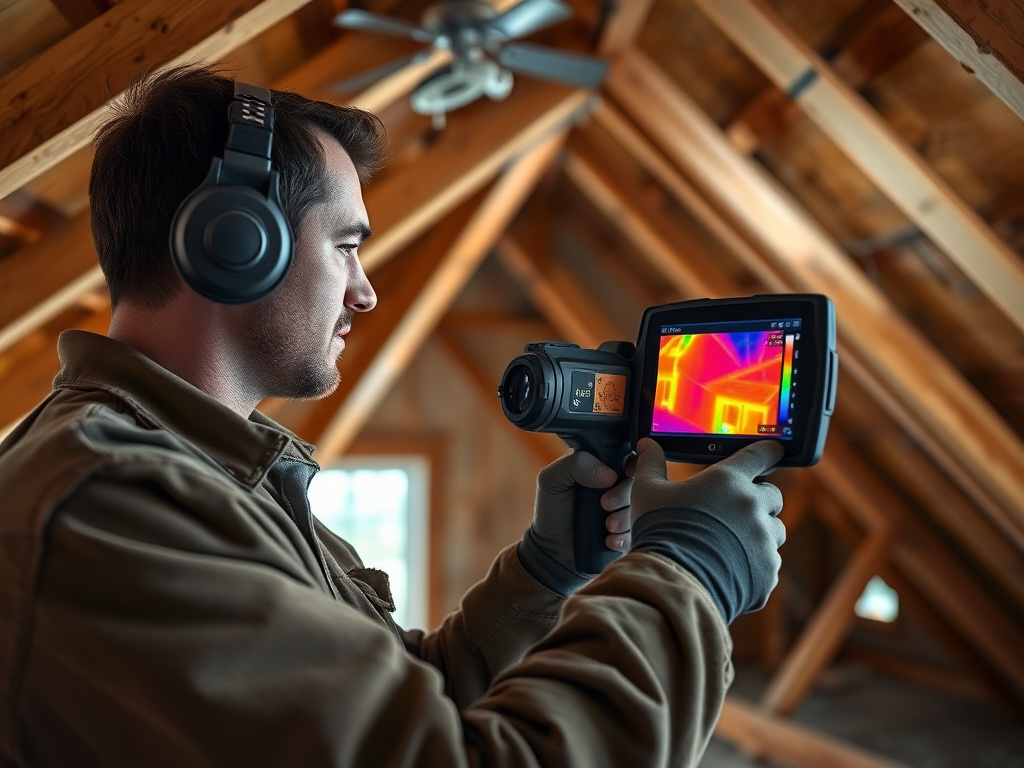
| Thermal imaging scan | An infrared camera pass across ceilings, walls, and window and door surrounds to find temperature anomalies — thin or missing insulation, air leaks, and thermal bridging that never show up during a visual walkthrough alone. |
|---|---|
| Blower-door test | A calibrated fan mounted in an exterior doorway depressurizes the house and measures whole-building air leakage as a single number, then helps pinpoint exactly where outside air is getting in. |
| Duct leakage test | Supply and return ductwork gets pressure-tested separately from the building envelope, since a leaky duct run sitting in a 150°F attic wastes conditioned air before it ever reaches a supply register. |
| Attic inspection | A direct look at roof-deck condition, existing insulation type and depth, ventilation baffles, can-light penetrations, and any rodent activity — common findings in older central-Yuma housing and farm-adjacent properties. |
| Insulation depth check | Depth measured at multiple points across the attic, not just near the access hatch, and compared against the R-38 code floor and R-49 recommended target so the report reflects the whole attic instead of one sample spot. |
What each test in a full audit measures, and why we run all four together.
What we actually find here
Regional findings — what Yuma-area audits turn up
The pattern of problems we find across Yuma, San Luis, Somerton, Wellton, and Fortuna Foothills isn't generic. Older housing stock, a large population of manufactured and park-model homes, and working farm and ranch outbuildings across Yuma County all show up in the audit data in ways a copy-paste desert checklist wouldn't anticipate.
- ✓Older homes in central Yuma and Somerton were frequently built with thin, aging insulation that never got upgraded as the house changed hands — some attics test out well below today's R-38 floor.
- ✓Manufactured and park-model homes across Yuma County's RV resorts often shipped from the factory with minimal insulation, on the assumption they'd see light seasonal use rather than a full desert summer.
- ✓Farm and ranch outbuildings — equipment shops, packing structures, storage buildings — were frequently never insulated at all when built, because nobody planned to spend real time working inside them in July.
- ✓Homes occupied only part of the year by winter visitors show a different pattern in a blower-door test than a full-time residence — infrequent HVAC cycling can mask leaks that only become obvious once someone is living there through a full summer.
None of this means every home needs the same fix. It means the audit is doing real work — telling us whether your specific property behaves like a typical central-Yuma retrofit, a factory-built home that needs its own assessment approach, or a farm property with outbuildings nobody has ever measured.
The honest math
The savings math for genuine sustained extreme heat
Yuma sits in IECC Climate Zone 2B — the same numeric zone as Phoenix, but with more sustained summer heat and essentially no winter cold to offset the math. January highs run around 70°F with lows near 51°F; sub-freezing nights are rare and brief. That means the audit's savings estimate isn't split across two seasons the way it would be in Arizona's higher-elevation or border-region markets — it's almost entirely a cooling-load story, start to finish.
| What drives the number here | In most of Arizona the savings math has to account for both a summer cooling season and a real winter heating season. Yuma barely has the second one. With January highs around 70°F and lows in the 50s, this is almost entirely a cooling-load story — every dollar of the fix goes toward the same problem, all year. |
|---|---|
| Typical range | A sealed-envelope conversion plausibly cuts cooling costs 20–40%, which for a typical Yuma-area home tends to land in the neighborhood of $700–$1,300 a year — directional figures we refine once we've measured your actual house, not a number we'd quote before ever seeing the property. |
| Payback timeline | Most attic and air-sealing projects here pay for themselves in roughly 3–7 years depending on scope, existing insulation condition, and current utility rates — a range worth treating as a planning estimate rather than a guarantee. |
| Why the sustained heat matters | Yuma logs more consecutive 100°F+ days most years than Phoenix, thanks to lower elevation and fewer monsoon interruptions. A leak that costs a Phoenix homeowner money for four months a year costs a Yuma homeowner money for closer to five — the audit's findings carry a longer runway before they stop mattering each season. |
Directional framing based on regional climate data — your audit report gives you numbers specific to your home, not a generic estimate.
The practical upshot: unconditioned Yuma attics commonly reach 140–160°F+ on summer afternoons, and Yuma is one of the sunniest places on Earth by measured daylight hours — so the roof deck and attic floor are absorbing solar heat almost every day of the year. A fix that addresses that heat gain keeps paying off for a genuinely longer stretch of the calendar than it would almost anywhere else in the state.
Rebate navigation
APS Home Performance rebate — what your audit qualifies you for
Every community we serve across Yuma County is Arizona Public Service (APS) territory — a genuinely simpler rebate conversation than markets split between two utilities. Confirming your eligibility for the APS Home Performance rebate is part of the audit itself, not a separate errand you have to run afterward.
| Utility territory | Yuma and all of Yuma County sit in Arizona Public Service (APS) territory — there's no SRP presence here and no split-utility conversation to navigate. One rebate program, one contact number. |
|---|---|
| APS Home Performance rebate | Up to $250 available through the APS Home Performance with ENERGY STAR path, where existing attic insulation tests at R-7 or less and gets brought up to a minimum of R-43. Your audit's insulation depth check is what confirms whether your home qualifies before any work is scheduled. |
| WACOG Weatherization Assistance Program | The Western Arizona Council of Governments runs a federally backed weatherization program for income-qualified households across La Paz, Mohave, and Yuma counties — covering attic insulation, air sealing, and related envelope work at no cost to eligible homeowners and renters (with landlord permission). Local office: 1235 S. Redondo Center Dr., Yuma, AZ 85365, (928) 782-1886. |
| Federal tax credit status for 2026 | The federal Energy Efficient Home Improvement Credit (Section 25C) ended after December 31, 2025 under the One Big Beautiful Bill Act. There is no federal credit available for 2026 insulation or air-sealing work — we say this plainly rather than advertise a credit that no longer applies. |
Program terms as of this writing — confirm current availability directly with APS and WACOG before finalizing a project budget.
We say the federal-credit line plainly because a lot of sites still advertise a program that no longer exists for 2026 work. If you're income-qualified and haven't looked into WACOG's weatherization assistance, it's worth a call before you pay for an audit at all — the program can cover attic insulation and air sealing directly for eligible households and renters.
What you get
Your audit report and prioritized fix list
At the end of the visit you get a written report, not a verbal impression. It documents your blower-door number, duct leakage results, thermal-imaging findings by room, and measured attic insulation depth against the R-38 code floor and R-49 recommended target for 2026 work. Where the property is a manufactured or park-model home, the report addresses skirting, underbelly insulation, and roof-over condition specifically, since those assemblies fail differently than a standard site-built attic.
We then rank the findings into a prioritized fix list: what's costing you the most conditioned air right now, what's a moderate-priority item, and what can reasonably wait. Not every finding needs to happen in the same visit or the same year — the point of the list is helping you sequence spending, not pushing every line item at once.
If you decide to move forward with install work, the audit becomes the starting point for your quote instead of a separate expense that gets thrown away. We don't re-measure your attic from scratch or re-run a blower-door test you already paid for — the numbers carry straight into the project scope, and the audit fee typically rolls into the install price rather than stacking on top of it.
That audit-to-install path also keeps your APS rebate paperwork and any WACOG eligibility documentation consistent, since both trace back to the same visit. For the most common next step after an audit, see our attic insulation page — it's where most prioritized fix lists start, and where the R-38-to-R-49 numbers from your report turn into an actual install spec.
Schedule the visit
We confirm property type — site-built, manufactured, or farm/ranch — and whether outbuildings or a seasonal-occupancy schedule should shape the scope.
Run the four tests
Thermal imaging, blower-door, duct leakage, and attic inspection with measured insulation depth at multiple points.
Deliver the report
A written, prioritized fix list plus APS Home Performance and WACOG eligibility confirmed against your home's insulation condition and income status.
Quote the fix (if you want one)
Audit findings roll directly into an install quote — no re-measuring, no duplicate charges.
Questions
Energy audit questions we hear most
How much does a home energy audit cost in Yuma?
+
Pricing depends on home size, whether outbuildings are included, and travel distance for rural Yuma County properties, so treat any number you see online as a directional estimate. Ask for a quote when you book and we'll confirm before the appointment — no surprise add-ons at the door.
Will the audit tell me if I qualify for the APS rebate?
+
Yes. Confirming your existing insulation's R-value against the R-7-or-less threshold, and whether bringing it up to R-43 is realistic for your attic, is part of the audit — not a separate step you have to chase down with APS afterward.
Do you audit manufactured or park-model homes, or just site-built houses?
+
Both. Given how many manufactured and park-model homes sit across Yuma County's RV resorts, we regularly audit skirting, underbelly insulation, and roof-over condition alongside the standard attic and duct tests — those factory-built assemblies have their own failure patterns worth checking specifically.
What happens after the audit — do I have to hire you for the repair work?
+
No. You get a written, prioritized fix list either way. If you decide to move forward with us, the audit findings roll directly into your install quote so you're not paying to have the same attic measured twice.
Find out where your home is actually losing energy
Book a full instrumented audit — thermal imaging, blower-door, duct leakage, attic inspection — and get a written, prioritized fix list plus a plain-language APS and WACOG rebate check.
Related reading
Go deeper on attic performance and regional cost
Attic Insulation
The most common fix an audit turns up — sealed roof-deck foam vs. conventional air-seal-plus-blow-in, specced to Yuma's sustained extreme heat.
2026 Cost & Climate Guide
Cost tables, the Zone 2B extreme-heat playbook, and a full cooling-savings model for Yuma County.
Service Areas
Local housing-stock notes for Yuma, San Luis, Somerton, Wellton, and Fortuna Foothills.