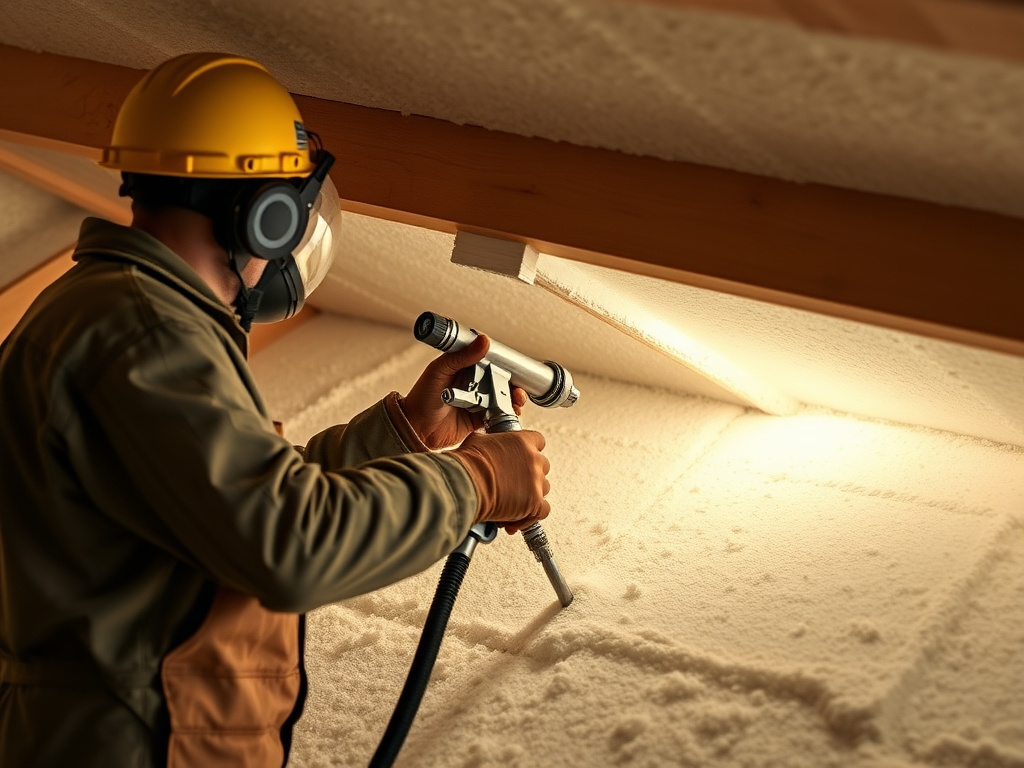
Open-cell spray foam
Open-Cell Spray Foam Insulation in Yuma, AZ
Half-pound expanding foam that seals every gap, seam, and stud bay in your attic or walls against Yuma's sustained extreme summer heat — the kind of complete air-seal that batt insulation and blown-in fiberglass were never built to deliver.
What open-cell foam actually is
A soft, fully-expanding foam built to seal — not to add strength
Open-cell spray foam is a two-component polyurethane foam that starts as a liquid at the tip of the spray gun and expands to roughly 100 times its original volume within seconds of hitting a surface. That expansion is what makes it different from every older insulation material on the market — instead of being cut, stuffed, or blown into a cavity from the outside, it grows into place and fills every irregular gap, wire run, plumbing penetration, and odd-angle rafter bay in a single pass.
The finished product is soft and a little spongy to the touch, at roughly half a pound per cubic foot — hence the trade nickname "half-pound foam." Its open cellular structure means the tiny bubbles created during expansion aren't fully sealed off from each other, which is exactly why it stays flexible instead of rigid. That same open structure is what gives it real sound-dampening properties, since airborne sound waves lose energy passing through all those open cells instead of bouncing off a solid surface.
On a per-inch basis, open-cell insulates at roughly R-3.5 to R-3.8 — lower than closed-cell foam, but applied at enough thickness to comfortably clear Yuma's recommended attic R-value targets in a single lift. Because it expands so completely, it also does something no batt or loose-fill product can do on its own: it air-seals the cavity at the same time it insulates it. In a hot desert climate, that combined air-seal-plus-insulate behavior is often more valuable than the R-value number by itself, since a huge share of unwanted heat gain in a Yuma attic comes from air leakage around top plates, recessed lighting, and duct penetrations — not just conduction through the insulation layer.
It's also vapor-permeable rather than vapor-tight, meaning it doesn't function as a vapor barrier the way closed-cell foam does. For a full side-by-side on when that distinction matters, see our closed-cell spray foam page.
Why it fits Yuma specifically
Air-sealing matters more than vapor control in a near-zero-heating climate
Yuma sits in IECC Climate Zone 2B — the same numeric zone as Phoenix, but with a longer, more sustained stretch of extreme heat and essentially no winter cold to speak of. July averages a high near 105°F, and 100°F-plus afternoons are routine from June through September. Because Yuma sits at a lower elevation than Phoenix and sees fewer monsoon-storm interruptions, it frequently logs more consecutive 100°F-plus days in a given year, even on stretches where Phoenix posts a higher single-day peak. Winter here is mild enough — January highs around 70°F, lows around 51°F — that a genuine heating season barely exists.
That climate profile changes which properties of an insulation product actually matter. In a cold climate, the debate over open-cell versus closed-cell often centers on vapor control — whether moisture-laden interior air can migrate into a wall cavity and condense against a cold sheathing layer in winter. Yuma's insulation math almost never runs into that scenario, because there's no sustained cold surface inside a wall assembly for humid air to condense against. What Yuma's insulation math is actually solving is a cooling-load problem: keeping superheated attic and exterior-wall air from working its way into conditioned living space, hour after hour, for months at a stretch.
Unconditioned attics in Yuma commonly reach 140–160°F or higher on a summer afternoon, driven by intense, sustained solar exposure — Yuma is widely cited as one of the sunniest places on Earth, with sunshine roughly 91% of possible daylight hours annually. Open-cell foam applied directly to the underside of the roof deck moves that entire boundary from the attic floor up to the roofline, and its complete air-seal stops the convective heat transfer that a gapped batt installation simply can't touch. That's the trade-off Yuma homeowners are actually optimizing for, and it's why open-cell's air-sealing behavior is arguably a bigger deal here than its raw R-value number.
Where it goes
Best applications for open-cell foam in Yuma-area buildings
Attic roof decks (unvented/sealed attics). The single most common application we install in Yuma is open-cell foam sprayed directly to the underside of the roof deck, converting a traditional vented attic into a sealed, conditioned space. This is especially valuable in the typical Yuma single-story layout where the air handler and ductwork already sit in the attic — sealing that space keeps your cooling system working in attic temperatures closer to your thermostat setting instead of fighting 150°F attic air on every cycle.
Interior walls. Open-cell is a strong choice for interior partition walls where sound control matters more than thermal performance — bedroom walls next to a home office, a media room, or a wall shared with a garage workshop. Its open-cell structure absorbs sound transmission noticeably better than fiberglass batt at the same thickness.
Sound dampening near flight paths and travel corridors. Properties near Marine Corps Air Station Yuma's flight paths, the I-8 corridor, or the San Luis port-of-entry traffic corridor see genuinely elevated ambient noise. Open-cell foam in exterior walls and roof assemblies measurably reduces how much of that noise makes it into living space, on top of its thermal performance.
Exterior residential walls in a mild-humidity climate. Because Yuma's day-to-day humidity runs low outside of brief summer monsoon spikes, open-cell's vapor permeability in exterior wall cavities isn't the drawback it can be in a wetter climate. It's a serviceable, cost-effective choice for standard residential wall framing across Yuma, San Luis, Somerton, Wellton, and Fortuna Foothills.
| Density | About half a pound per cubic foot ("half-pound foam") — a soft, flexible cellular structure rather than a rigid one. |
|---|---|
| R-value per inch | Roughly R-3.5 to R-3.8 per inch, so a full roof-deck fill typically lands in the R-30s to low R-40s depending on rafter or truss depth. |
| Expansion | Expands to roughly 100 times its liquid volume on application, which is what lets it fill irregular framing bays, wiring runs, and odd cavity shapes completely. |
| Vapor behavior | Vapor-permeable — it does not act as a vapor barrier, which is a non-issue in a climate like Yuma's where the dominant load is cooling, not moisture-driven wall assemblies. |
| Sound performance | Its open cellular structure absorbs airborne sound meaningfully better than fiberglass batt at comparable thickness, relevant near I-8 truck traffic, the San Luis port corridor, and MCAS Yuma flight paths. |
| Re-occupancy | Typically safe to re-enter the treated space in about 24 hours once off-gassing and initial cure have progressed, weather and ventilation permitting. |
General open-cell foam characteristics — actual R-value achieved depends on installed thickness and framing depth.
Cost
What open-cell spray foam typically costs in Yuma
Spray foam is priced by the board foot — one board foot is a one-square-foot area sprayed one inch thick. As a directional range for this region, open-cell typically runs about $0.45 to $0.90 per board foot installed, with most contractors carrying a minimum job charge somewhere around $1,500 to $2,200 regardless of square footage. These figures are planning-level estimates, not a guaranteed price — your actual number depends on roof-deck access, whether old insulation needs to come out first, and the exact R-value target for your job.
Worked example: a 2,000 square foot single-story home with a standard truss roof, sprayed at the roof deck to reach roughly R-38 (the 2018 IECC-derived Zone 2B floor), typically lands in the range of about $2,250 to $5,000 installed for a full attic job — toward the lower end for straightforward access and new-truss framing, toward the higher end for tight access, an older roof structure, or a target closer to the R-49 recommended for new work. Homes with prior insulation that needs removal first should also budget for that step separately — see our insulation removal page.
Two things worth knowing about the current rebate landscape: APS's Home Performance path offers up to $250 for bringing existing attic insulation of R-7 or less up to R-43, and the Western Arizona Council of Governments (WACOG) runs a federally-backed Weatherization Assistance Program for income-qualified households across Yuma, La Paz, and Mohave counties at no cost to eligible participants. The federal 25C tax credit that used to apply to insulation upgrades ended after December 31, 2025 under the One Big Beautiful Bill Act — it is not available for 2026 installs, and we'll tell you that plainly rather than let you plan around a credit that no longer exists.
Open-cell vs. closed-cell
When we'd recommend open-cell instead of closed-cell
Open-cell and closed-cell foam solve overlapping problems with different trade-offs. Open-cell costs less per board foot, expands further per unit of material, and excels at sound dampening — but it takes roughly double the thickness of closed-cell to reach the same R-value, and it doesn't add structural rigidity to the assembly it's sprayed into. Closed-cell costs more, but delivers roughly double the R-value per inch, adds real racking strength to a wall or roof assembly, and functions as a Class II vapor retarder — which matters a great deal on metal buildings, packing sheds, and cold-storage structures tied to Yuma County's produce industry.
| Best fit | Attic roof decks, interior walls, and sound-dampening assemblies where air-sealing is the main job and structural rigidity isn't required. |
|---|---|
| Cost position | Lower installed cost per board foot than closed-cell, though it takes more material thickness to reach the same R-value. |
| When we'd steer you to closed-cell instead | Metal buildings, packing sheds and cold-storage structures, exterior wall assemblies exposed to bulk moisture, or any assembly where the foam itself needs to add rigidity to the structure. |
For the full technical comparison and the agricultural cold-storage case, see our closed-cell spray foam page.
Most standard Yuma homes are well served by open-cell in the attic roof deck and interior walls. Metal shops, detached garages, and any structure with a moisture-control concern typically call for closed-cell, or a hybrid approach mixing both. Read the full breakdown on our closed-cell spray foam page, or see the complete cost and climate picture in our Yuma spray foam cost & climate guide.
Install process
What happens on an open-cell spray foam install day
Inspect & measure
We measure the attic or wall area, check existing insulation condition, and confirm access, ventilation baffles, and any prior contamination that needs addressing first.
Prep the space
Surfaces are masked and protected, recessed lighting and electrical boxes are addressed for thermal/ignition clearance, and any old insulation slated for removal comes out before spraying begins.
Spray application
Foam is applied in controlled lifts to reach the target thickness and R-value, with technicians monitoring cell structure and adhesion as they go.
Cure, inspect & walkthrough
The space is typically safe to re-enter in about 24 hours. We walk the finished job with you, note the R-value achieved, and flag anything relevant to your HVAC system's next service.
Code compliance basics
What code requires for open-cell foam installs
Sealed (unvented) attic assemblies using spray foam applied directly to the roof deck are addressed under IRC Section R806.5, which sets out the conditions an unvented attic assembly has to meet — including air-impermeable insulation applied directly to the underside of the roof deck, which open-cell foam satisfies at sufficient thickness. This is a well-established, code-recognized construction method, not a workaround.
Thermal barrier and ignition barrier requirements also apply to foam installed in living space or attics accessible for storage or future living use — typically meaning exposed foam needs to be covered with an approved thermal barrier material (commonly drywall) or an approved ignition-barrier coating in attic and crawlspace applications where it will remain exposed.
- ✓Confirm unvented-attic assembly meets IRC R806.5 conditions before spraying the roof deck
- ✓Verify ignition-barrier or thermal-barrier requirements are met for any exposed foam
- ✓Maintain required clearance around recessed lighting and electrical devices
- ✓Document R-value achieved for any rebate or resale disclosure purposes
- ✓Confirm permit requirements with your local jurisdiction before work begins, where applicable
Common questions
Open-cell spray foam FAQ
Is open-cell spray foam a good fit for Yuma's climate, or is that mainly a cold-climate product?
+
It's a strong fit here, just for a different reason than in a cold climate. In freeze climates, open-cell's vapor permeability is part of a bigger conversation about where a wall assembly needs a vapor retarder. Yuma's Zone 2B climate runs almost entirely on cooling load, with essentially no winter heating season to complicate that picture, so the vapor-permeability question mostly falls away. What's left is the part that matters most here — a complete air seal against attic and wall infiltration during a summer that regularly delivers 100°F-plus days from June through September.
How much does open-cell spray foam cost in Yuma, AZ?
+
As a directional range, open-cell typically runs about $0.45 to $0.90 per board foot installed, with most contractors carrying a minimum job charge in the neighborhood of $1,500 to $2,200 regardless of size. A full attic roof-deck job on a 1,500 to 2,200 square foot home often lands somewhere between $2,250 and $5,000 installed. These are planning-level figures, not a quote — your actual number depends on roof-deck access, existing insulation removal, and the R-value target you're spraying to.
Will open-cell foam interfere with my attic ductwork or vents?
+
No — in fact, for the common Yuma layout where the HVAC air handler and ductwork sit inside the attic, open-cell applied to the roof deck typically moves that entire space inside the conditioned building envelope. That's a meaningful difference from a vented attic with blown-in insulation on the floor, where ductwork sitting in 140-160°F attic air is fighting the heat the whole time it's trying to deliver cool air to your rooms.
Do I need to worry about off-gassing or chemical smell after installation?
+
There's a cure period, and it's normal to notice an odor immediately after spraying that fades over the following day or two. We give a straightforward re-occupancy window — typically about 24 hours — based on ventilation and cure conditions on your specific job, and we won't tell you it's ready before it actually is.
Ready to seal your attic against Yuma's summer heat?
Tell us about your property and we'll come back with a straightforward open-cell foam plan — no obligation.
Related reading
Go deeper on foam choice, attics, and cost
Closed-Cell Spray Foam
Higher R-value per inch, added structural rigidity, and a genuine moisture barrier for metal buildings and Yuma County's packing sheds and cold-storage facilities.
Attic Insulation
How sealed and conventional attic strategies compare for Yuma's 140–160°F attic temperatures, plus current rebate options.
Yuma Spray Foam Cost & Climate Guide
Full cost tables, savings modeling, and the extreme-heat climate breakdown behind every number on this page.