Every property owner who calls a Yuma spray foam contractor eventually asks the same question: open-cell or closed-cell? The honest answer is “it depends on the assembly,” but that answer is more useful once you understand what actually separates the two products and why Yuma's specific climate — sustained triple-digit heat for months at a stretch, essentially no winter cold, and (in the agricultural parts of the county) real cold-storage and pre-cooling buildings — tips the decision one way or the other for each part of a building.
This guide walks through the decision in the order it actually comes up on a job: a 60-second comparison table, what density and R-per-inch and vapor behavior mean in plain language, why Yuma's climate changes the usual advice, and then a practical, assembly-by-assembly breakdown — including the packing-shed and cold-storage case that makes this county different from almost anywhere else in Arizona.
The 60-second decision table
If you only read one section, read this one. Here's how open-cell and closed-cell spray foam stack up on the attributes that actually drive the decision.
| Attribute | Open-Cell (half-pound) | Closed-Cell (2-lb) |
|---|---|---|
| Density | About 0.5 lb/cubic ft — soft, spongy, easily compressed by hand | About 2 lb/cubic ft — rigid, dense, holds its shape under pressure |
| R-value per inch | Roughly R-3.5 to R-3.8 | Roughly R-6 to R-7 — nearly double the R-value in the same cavity depth |
| Expansion | Expands to roughly 100x its liquid volume, filling irregular framing bays completely | Expands to roughly 30-40x its liquid volume — more controlled, applied in metered lifts |
| Vapor behavior | Vapor-permeable — air movement stops, but water vapor can still pass through slowly | A Class II vapor retarder at typical application thickness — vapor movement is substantially reduced |
| Sound dampening | Excellent — the open cell structure absorbs airborne sound well | Good, but the rigid, dense structure isn't as effective at sound absorption as open-cell |
| Added rigidity | None — stays soft, does not add racking strength to framing or panels | Meaningful — bonds to and stiffens the assembly, which matters on metal buildings |
| Typical directional cost | Roughly $0.45-$0.90 per board foot | Roughly $1.00-$1.65 per board foot |
| Best general fit in Yuma | Attic roof decks, interior stud walls, sound control between rooms | Metal buildings, packing sheds & cold storage, block/CMU walls, exterior applications |
Cost figures are directional, typical ranges seen across Zone 2B Arizona jobs — not a quoted price. Your exact number depends on square footage, thickness, access, and service radius. Ask for a written estimate for your property.
Density, R-per-inch, and vapor behavior — in plain language
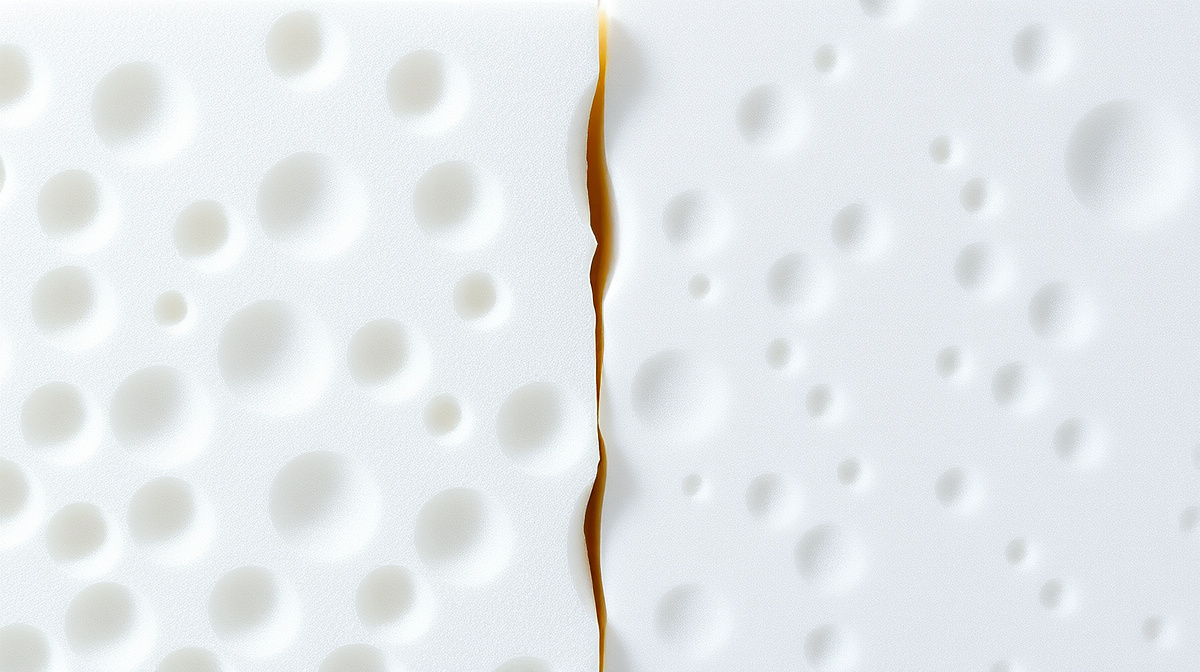
Density is the easiest difference to feel with your hand. Open-cell foam cures soft and spongy — the tiny cells inside it are broken open, which is why it expands so dramatically and fills irregular framing cavities so completely. Closed-cell foam cures rigid, almost like a hard foam board — the cells stay sealed shut, which is why it's denser, stiffer, and holds up to a hand-press without giving way.
R-value per inch is a direct result of that cell structure. Closed cells trap gas more effectively than open cells, so closed-cell foam delivers roughly R-6 to R-7 of thermal resistance per inch of thickness, against roughly R-3.5 to R-3.8 per inch for open-cell. In practice, that means a 2-inch closed-cell application can land in the same R-value neighborhood as a 4-inch open-cell application — which matters a great deal in a shallow rafter bay or a metal-building wall where depth is limited.
Vapor behavior is the one most people skip past, and it's the one that actually decides most of the assembly-by-assembly picks below. Open-cell foam stops air movement cold, but it's vapor-permeable — water vapor can still work its way through it slowly, the same way it can through a permeable paint. Closed-cell foam, applied at a typical thickness, behaves as a Class II vapor retarder — it slows vapor movement to a crawl in addition to stopping air movement outright. In a climate with a real winter freeze-thaw cycle, that difference drives long debates about where vapor retarders belong in a wall assembly. In Yuma, it drives a much shorter one.
Why Yuma's climate simplifies (and complicates) the usual advice
Yuma sits in IECC Climate Zone 2B — the same numeric zone as Phoenix — but it runs hotter for longer. Summer highs commonly sit at 100°F or above from June through September, Yuma logs fewer monsoon-storm interruptions than Phoenix, and it sits at a lower elevation, which together mean Yuma frequently strings together more consecutive 100°F-plus days per year than Phoenix does, even when Phoenix edges it out on an isolated single-day peak. Winters, meanwhile, are mild even by Arizona standards — January highs average around 70°F with lows in the low 50s, and sub-freezing nights are rare and brief.
That combination — a long, punishing cooling season and almost no heating season — simplifies the classic vapor-barrier debate that dominates spray foam decisions in colder climates. There's no freeze-thaw cycle driving moisture back and forth through a wall assembly twice a year, and there's no real heating-season interior humidity load pushing vapor outward through the envelope in winter. For most Yuma homes, the insulation conversation is almost entirely about air-sealing against radiant heat gain, not about managing a two-way vapor drive.
That's exactly why open-cell foam does so much of the work on ordinary Yuma homes — attic roof decks and framed stud walls don't need a vapor retarder nearly as much as they need the building envelope sealed against 140-160°F attic temperatures pushing heat downward all summer. But it also explains why the calculus flips hard the moment a building has a genuinely different moisture problem to solve — which is exactly the situation inside a refrigerated or pre-cooling structure, covered below.
Assembly-by-assembly: which foam goes where
The right answer changes by assembly, not by property type. Here's how it plays out across the buildings we work on most across Yuma and Yuma County.
Attic roof decks (unvented, conditioned attics)
This is open-cell's home turf in Yuma. Spraying the underside of the roof deck with open-cell foam converts a vented attic into part of the conditioned building envelope, which matters enormously in a market where attic ductwork is standard and unconditioned attics commonly hit 140-160°F on a summer afternoon. Open-cell fills irregular rafter bays completely at a lower cost per board foot than closed-cell, and since the goal here is stopping heat transfer and air leakage — not managing vapor drive through a wall — the vapor-permeable nature of open-cell isn't a drawback here, it's simply a non-issue for this application in this climate. See our open-cell spray foam page for the full rundown, including cure time and code notes for unvented attic assemblies.
Interior stud walls
Interior partition walls — between a garage and living space, around a bedroom facing a noisy street, or near mechanical rooms — are another open-cell strength. It absorbs airborne sound noticeably better than closed-cell, which is a genuine, practical consideration for homes near I-8, the San Luis port corridor, or under a Marine Corps Air Station Yuma flight path.
Metal buildings, shops & RV garages
Once you're dealing with a metal building — a farm shop, a detached RV garage, a toy hauler building common across Yuma's large winter-visitor community — the calculus shifts toward closed-cell. Metal surfaces swing in temperature fast, and a metal roof or wall panel that gets cold enough overnight (or stays cold thanks to interior air conditioning) can condense moisture out of humid air, especially during Yuma's summer monsoon humidity spikes. Closed-cell foam bonds directly to the metal, stops that condensation cycle, and adds real rigidity to the panel assembly — a genuine structural bonus that open-cell simply doesn't provide. Our garage & RV insulation page covers this in more depth for shops and detached buildings specifically.
Packing sheds, pre-cooling facilities & cold storage — the Yuma County case
This is where Yuma's decision diverges most from a generic Arizona insulation conversation. Yuma County is widely known as the “Winter Lettuce Capital of the World,” producing an estimated 90%+ of the leafy greens consumed in North America each winter across roughly 175,000 irrigated acres. That agricultural economy runs on packing sheds, pre-cooling facilities, and cold-storage buildings that hold produce at temperatures far below the outside air — and every one of those buildings has a condensation problem that an ordinary metal building simply doesn't have. Warm, occasionally humid Yuma air meeting a cold interior surface is a textbook setup for condensation, and condensation on an uncontrolled envelope means dripping ceilings, saturated insulation, and product-quality risk in a facility that can't afford downtime during the November-through-April harvest window.
Closed-cell foam isn't optional here — it's close to the only real answer. Its Class II vapor-retarder performance and continuous air seal are exactly what keeps humid air from ever reaching the cold side of the envelope in the first place, which is a fundamentally different (and more reliable) strategy than trying to manage condensation after it forms. We've written a full breakdown of this exact problem — the moisture mechanics, the metal-building specifics, and how project scheduling works around harvest season — in Insulating Yuma's Packing Sheds and Cold-Storage Buildings. If you manage or own one of these facilities, that's the next thing to read.
Block, CMU & below-grade walls
Concrete block and masonry walls — common on older central-Yuma commercial buildings and some farm outbuildings — favor closed-cell as well, since it bonds well to masonry substrates and its vapor-retarder characteristics help manage the moisture that can wick through block from grade-adjacent soil, particularly on irrigation-adjacent properties.
The cost delta, directionally speaking
Closed-cell costs more per board foot than open-cell — typically in the range of roughly $1.00-$1.65 per board foot versus roughly $0.45-$0.90 for open-cell, based on the pricing bands typically seen across Zone 2B Arizona jobs. But that comparison only tells half the story, because closed-cell also delivers roughly double the R-value per inch. On an assembly where you need a specific R-value in limited depth — a shallow metal-building wall cavity, for instance — the effective cost gap narrows once you account for needing less thickness of closed-cell to hit the same target. These figures are directional planning numbers, not a quote; your actual project cost depends on square footage, access, thickness spec, and how far the job sits from our home service radius toward Wellton, San Luis, or outlying county areas.
RV garages & manufactured homes — a quick note
Yuma County's population roughly doubles every winter with snowbirds and RV-resort residents, which makes RV garages, toy-hauler buildings, and manufactured or park-model homes a real, recurring part of the local foam conversation — not a niche afterthought. Detached RV garages generally follow the metal-building logic above (closed-cell). Manufactured and park-model homes vary more by construction type; underbelly and skirting work often calls for closed-cell's moisture resistance, while conditioned interior additions can often use open-cell the same way a site-built home would. A quick property walkthrough settles this faster than a general rule can.
Still not sure which one fits your project?
Most Yuma properties end up using a mix — open-cell where air-sealing against sustained heat is the whole job, closed-cell where moisture, structural rigidity, or a tight cavity depth changes the equation. The fastest way to get a real answer is a property walkthrough rather than a guess from a general rule of thumb.
- ✓Open-cell fits most attic roof decks, interior partition walls, and standard framed assemblies in Yuma's climate.
- ✓Closed-cell fits metal buildings, packing sheds and cold storage, block/CMU walls, and anywhere cavity depth is limited.
- ✓Cost differences are directional — get a written, property-specific estimate before comparing quotes line by line.
- ✓Many Yuma projects genuinely use both foam types on different parts of the same building.