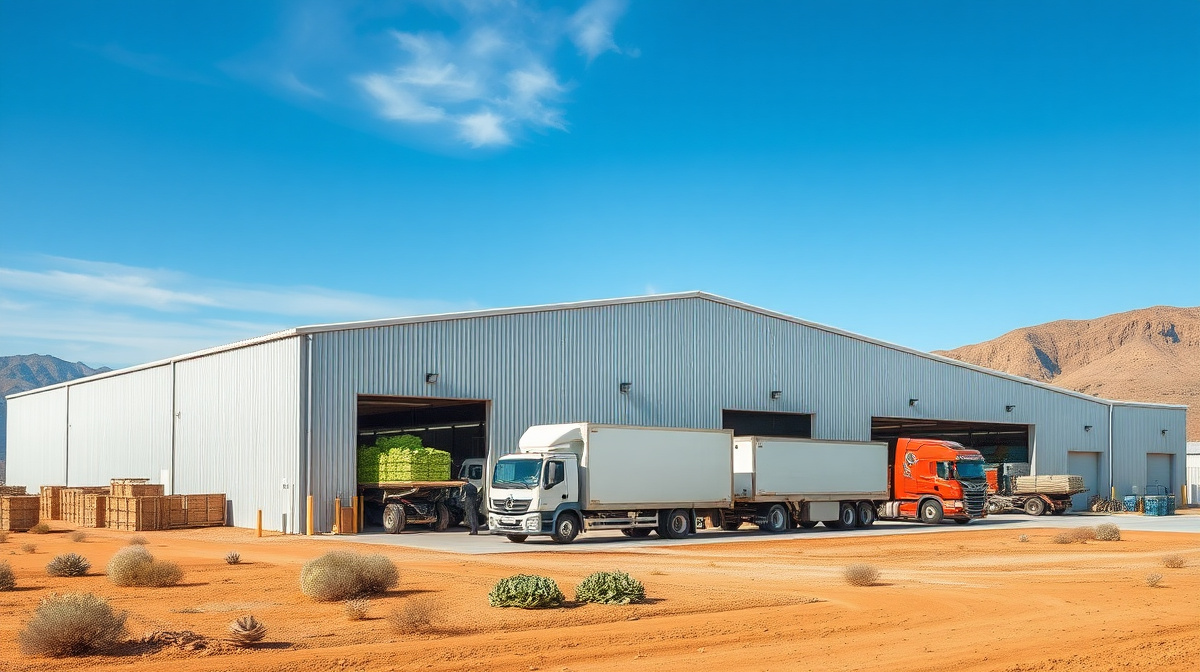
If you manage or own a packing shed, a pre-cooling facility, or a cold-storage building anywhere in Yuma County, you already know something most general commercial insulation contractors don't fully grasp: your building has a moisture problem that a standard warehouse or office simply doesn't have. Fiberglass batts and standard blown-in insulation were designed for buildings that stay roughly the same temperature as the air around them. A room that's deliberately held 40, 50, even 70 degrees colder than the Yuma air outside it is a different engineering problem entirely — and getting the envelope wrong doesn't just waste energy, it puts product quality and building longevity at risk during the exact weeks of the year your facility can least afford downtime.
This guide covers what actually makes Yuma's packing-shed and cold-storage insulation problem distinct, why closed-cell spray foam is close to the only reliable fix, what changes on a metal building specifically, and how to schedule the work around a harvest calendar that runs from November through April.
The scale of Yuma's winter produce economy
Yuma is widely known as the “Winter Lettuce Capital of the World.” From roughly November through April each year, Yuma County is estimated to produce more than 90% of the leafy greens consumed across North America, with industry figures commonly citing somewhere around 170 million servings of lettuce produced per day during peak season. Yuma County ranks first in Arizona and third in the nation for vegetable production, anchored by roughly 175,000 acres of irrigated cropland served by farmer-operated water districts drawing some of the oldest water rights on the Colorado River.
That's a fundamentally different regional role than a border-crossing or import corridor — Yuma County is where this produce is actually grown, harvested, packed, cooled, and shipped out, all within a compressed and highly seasonal window. Every acre of that production ultimately funnels through a physical building: a field packing shed, a pre-cooling facility that pulls field heat out of freshly harvested greens before they ever reach a truck, or a cold-storage warehouse holding product at a controlled temperature until it moves. Each of those building types runs on a tight seasonal schedule, and each one has an envelope problem that a generic metal warehouse insulation approach won't solve.
Why refrigerated buildings have a condensation problem ordinary insulation doesn't solve
Here's the physics in plain terms. Warm air can hold far more water vapor than cold air. When warm, humid air meets a cold surface — a refrigerated wall panel, a metal roof deck over a pre-cooling room, a chilled ceiling — that air can't hold onto its moisture anymore, and the excess condenses directly onto that cold surface. Yuma's air is dry most of the year, but summer monsoon humidity spikes and general seasonal swings still put enough moisture into the air to make this a real, recurring problem for any building that maintains a genuinely cold interior against a much warmer, sometimes humid exterior.
Standard fiberglass batt or blown-in insulation doesn't stop this, because it doesn't stop air movement. Air — carrying its water vapor with it — can move through and around batt insulation, through gaps at penetrations, and along framing members, until it reaches a cold enough surface to condense. On a metal building, the result is the phenomenon contractors in this trade sometimes call a “raining ceiling”: condensation forms on the underside of a cold metal roof deck, collects, and drips onto product, packaging, or equipment below. Over time, that same moisture cycle saturates batt insulation, reduces its effectiveness further, and creates conditions that encourage mold and material breakdown inside wall and ceiling cavities — exactly what a facility handling fresh produce cannot afford.
The core issue isn't that the insulation lacks R-value. It's that batt and blown-in products were never designed to stop the air movement that carries moisture to a cold surface in the first place. Solving a condensation problem requires solving an air-movement problem — and that's a job for a continuous, adhered, air-sealing material, not a fibrous product that moisture and air can pass straight through.
Pre-cooling rooms, packing floors & cold storage: three different thermal jobs
It helps to be specific about what “refrigerated building” actually means in a Yuma County packing operation, because the envelope demands shift depending on which stage of the process a room handles. A field packing floor — where harvested greens are trimmed, sorted, and boxed — usually runs cool but not cold, and the bigger envelope concern there is often heat gain from equipment and constant door traffic more than deep-cold condensation control.
A pre-cooling room is a different animal entirely. Forced-air cooling (pulling refrigerated air through stacked boxes) and hydrocooling (running chilled water over or through the product) are both common methods for stripping field heat out of freshly harvested lettuce and leafy greens fast — often within an hour or two of harvest — and the rooms housing that equipment run at sustained near-freezing temperatures for hours at a stretch, cycling repeatedly through a harvest day. That combination of a cold, often humid interior air stream (especially with hydrocooling, where water vapor is part of the process) and a hot Yuma exterior is exactly the condensation setup described above, at its most extreme.
Cold-storage and distribution rooms, by contrast, hold a steadier, less extreme temperature for longer, less-interrupted stretches — the condensation risk is real but more constant and predictable than a pre-cooling room's repeated hot-to-cold cycling. In practice, this means a single packing facility can need a closed-cell envelope specified a little differently room by room — pre-cooling and hydrocooling areas typically warrant the most aggressive air-sealing and vapor-retarder detail, while packing floors and office or break areas may not need the same treatment at all. A generic, one-spec-fits-the-whole-building approach misses this distinction; a proper scope walks the facility room by room.
Closed-cell spray foam as the fix — in plain language
Closed-cell spray foam solves this problem structurally, not incidentally. It's applied as a liquid that expands and cures into a continuous, adhered layer that seals directly to the roof deck, wall panel, or framing it's sprayed against — there are no gaps, no seams, and no path for air to travel around it the way air can move around a batt. Because the cell structure inside closed-cell foam stays sealed shut (rather than open, the way it does in half-pound foam), it also behaves as what's known as a Class II vapor retarder at typical application thickness — meaning water vapor moving with that air is slowed to a crawl in addition to the air itself being stopped outright.
In practical terms: warm, humid Yuma air simply never reaches the cold interior surface of a properly foamed pre-cooling room or cold-storage wall, because the foam has already sealed off the path that air would have used to get there. That's a fundamentally more reliable strategy than trying to manage condensation after it forms — no dehumidification schedule, no periodic wipe-down, no ongoing maintenance item, just an envelope that doesn't let the problem start in the first place. It also delivers roughly R-6 to R-7 of thermal resistance per inch, nearly double open-cell foam's R-value per inch, which matters directly for the energy cost of running mechanical refrigeration and pre-cooling equipment through a Yuma summer. For the broader comparison between the two foam types and where each one fits on a typical property, see Open-Cell vs. Closed-Cell Spray Foam for Yuma's Extreme Desert Climate.
Metal-building specifics
Most packing sheds, pre-cooling facilities, and cold-storage buildings in Yuma County are pre-engineered metal buildings, and that construction type has its own set of considerations worth understanding before a project starts.
- ✓Direct application to the roof deck and wall panels — closed-cell foam is sprayed directly against the interior face of standing-seam roofing and metal wall panels, bonding to the metal itself rather than sitting loosely against it the way batt insulation does between purlins.
- ✓Purlin and girt encapsulation — foam is applied to fully encapsulate the steel framing members (purlins on the roof, girts on the walls), since an uninsulated steel member can itself become a cold spot where condensation forms even after the field between members is foamed.
- ✓Added structural rigidity — closed-cell foam bonds to and stiffens the panel assembly it's sprayed against, a genuine secondary benefit on large-span metal roof and wall systems.
- ✓Thermal and ignition barrier code requirements — most interior spray foam applications require an approved thermal or ignition barrier over the foam in occupied space, per code; this gets specified and detailed as part of the project scope, not treated as an afterthought.
- ✓Dock doors, curtain walls & loading areas — these are common thermal and air-leakage weak points on packing and cold-storage buildings and need targeted foam and sealing detail, not just a blanket application across the open field.
Project logistics around the November-April harvest season
Yuma County's packing and cold-storage facilities run on a harvest calendar, and a spray foam project needs to work with that calendar rather than against it. Peak facility activity runs roughly November through April, when packing sheds and pre-cooling operations are running at or near capacity to move the season's leafy greens. That makes the off-season — roughly May through October — the best window for new installation or a major retrofit on an existing facility, when a building can be taken fully or partially offline without disrupting harvest-season throughput.
That said, plenty of legitimate project work happens during the season itself — targeted repairs, additions to an expanding facility, or new construction phased to be ready before the next harvest ramp-up. For occupied-facility work during the season, scheduling typically centers on:
Scope & phase the work
Identify which sections of the building can be isolated or worked on without stopping produce flow through the rest of the facility.
Schedule around shipping windows
Plan spray days and cure time around loading schedules and peak shipping hours rather than around a generic weekday calendar.
After-hours & off-shift spraying
Much of the actual spray application on an active facility happens during off-shift hours to avoid disrupting daytime packing and loading operations.
Cure & re-occupancy time
Closed-cell foam typically allows re-occupancy of a sprayed area within about 24 hours, which is factored directly into the phased schedule.
The honest framing for any facility manager: off-season work is simpler and generally more cost-efficient, but in-season work is entirely workable when it's scoped and phased around your specific shipping and packing schedule rather than treated as a generic commercial insulation job.
Not just packing sheds
This same condensation-control logic extends beyond the packing shed floor itself. Farm and ranch outbuildings, agricultural processing buildings, and warehouses across Yuma County's growing regions all benefit from the same closed-cell approach whenever they hold a temperature meaningfully different from the outside air. If your operation includes any mix of packing, pre-cooling, cold storage, processing, or general agricultural warehouse space, the envelope conversation is largely the same one outlined above, adjusted for the specific temperature spread and building layout.
Getting a project scoped
Every packing shed and cold-storage building is a little different — building age, existing insulation condition, refrigeration load, and how the facility operates during harvest season all factor into a real scope of work. The most useful first step is a walkthrough of the specific building, not a generic square-footage estimate, so the phasing and timing can be built around how your facility actually runs.
Related pages: Commercial Spray Foam · Closed-Cell Spray Foam · Open-Cell vs. Closed-Cell Spray Foam